
This blog explores the depth of knowledge acquired by Large Language Models (LLMs), such as the Transformer. The knowledge obtained can be categorized into linguistic knowledge and factual knowledge. Linguistic knowledge includes understanding language structure and rules, while factual knowledge encompasses real-world events and common-sense notions.
The blog explains that LLMs acquire linguistic knowledge at various levels, with more fundamental language elements residing in lower and mid-level structures, and abstract language knowledge distributed across mid-level and high-level structures. In terms of factual knowledge, LLMs absorb a significant amount of it, mainly in the mid and high levels of the Transformer model.
The blog also addresses how LLMs store and retrieve knowledge. It suggests that the feedforward neural network (FFN) layers in the Transformer serve as a Key-Value memory system, housing specific knowledge. The FFN layers detect knowledge patterns through the Key layer and retrieve corresponding values from the Value layer to generate output.
Furthermore, the blog discusses the feasibility of correcting erroneous or outdated knowledge within LLMs. It introduces three methods for modifying knowledge in LLMs:
Correcting knowledge at the source by identifying and adjusting training data;
Fine-tuning the model with new training data containing desired corrections;
Directly Modifying model parameters associated with specific knowledge.
These methods aim to enhance the reliability and relevance of LLMs in providing up-to-date and accurate information. The blog emphasizes the importance of adapting and correcting knowledge in LLMs to keep pace with evolving information in real-world scenarios.
In conclusion, this blog sheds light on the depth of knowledge acquired by LLMs, how it is stored and retrieved, and strategies for correcting and adapting knowledge within these models. Understanding these aspects contributes to harnessing the full potential of LLMs in various applications.
Introduction
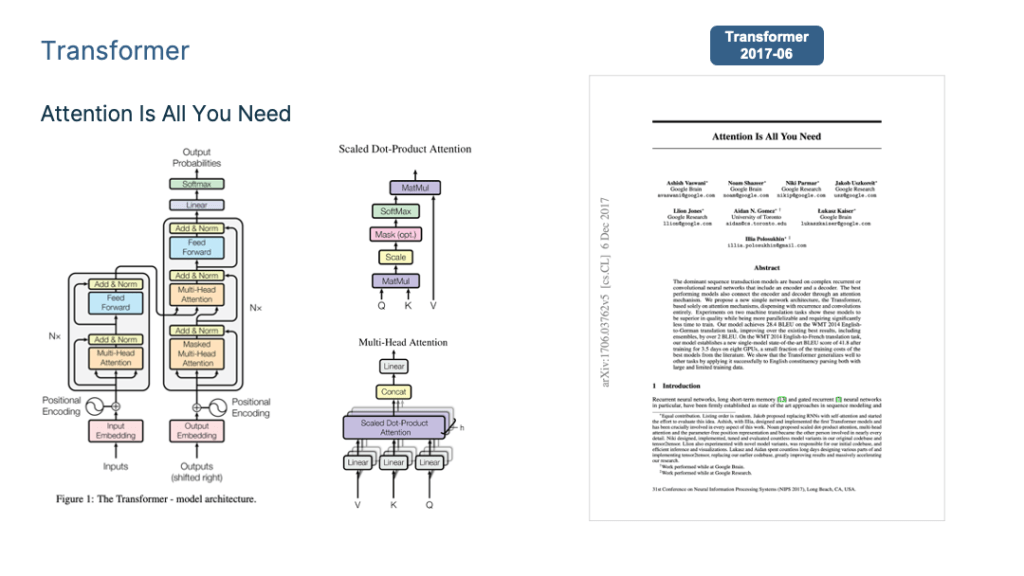
Judging from the current Large Language Model (LLM) research results, the Transformer is a sufficiently powerful feature extractor and does not require special improvements.
So what did Transformer learn through the pre-training process?
How is knowledge accessed?
How do we correct incorrect knowledge?
This blog discusses the research progress in this area.
Unveiling the Depth of LLM Knowledge
Large Language Models (LLM) acquire a wealth of knowledge from extensive collections of free text. This knowledge can be broadly categorized into two realms: linguistic knowledge and Factual knowledge.
Linguistic Knowledge
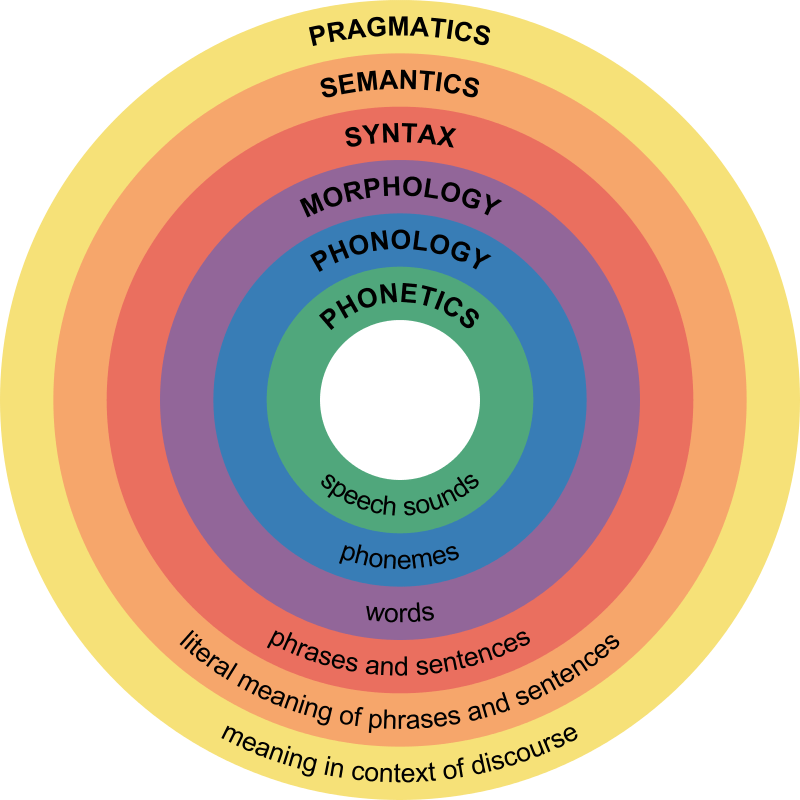
This encompasses understanding the structure and rules of language, including morphology, parts of speech, syntax, and semantics. Extensive research has affirmed the capacity of LLM to grasp various levels of linguistic knowledge.
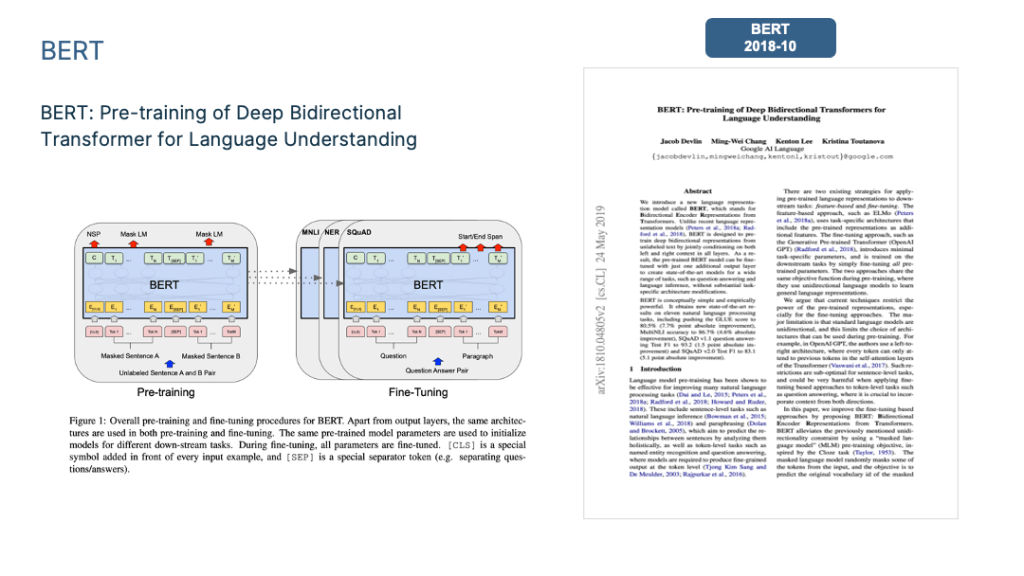
Since the emergence of models like Bert, numerous experiments have validated this capability. The acquisition of such linguistic knowledge is pivotal, as it substantially enhances LLM’s performance in various natural language understanding tasks following pre-training.
Additionally, investigations have shown that more fundamental language elements like morphology, parts of speech, and syntax reside in the lower and mid-level structures of the Transformer, while abstract language knowledge, such as semantics, is distributed across the mid-level and high-level structures.
Factual Knowledge
This category encompasses both factual knowledge, relating to real-world events, and common-sense knowledge.
Examples include facts like “Biden is the current President of the United States” and common-sense notions like “People have two eyes.”
Numerous studies have explored the extent to which LLM models can absorb world knowledge, and the consensus suggests that they indeed acquire a substantial amount of it from their training data.
This knowledge tends to be concentrated primarily in the mid and high levels of the Transformer model. Notably, as the depth of the Transformer model increases, its capacity to learn and retain knowledge expands exponentially. LLM can be likened to an implicit knowledge graph stored within its model parameters.
The conclusion drawn is that for Bert-type language models, a corpus containing 10 million to 100 million words suffices to learn linguistic knowledge, including syntax and semantics. However, to grasp factual knowledge, a more substantial volume of training data is required.
This is logical, given that linguistic knowledge is relatively finite and static, while factual knowledge is vast and constantly evolving. Current research demonstrates that as the amount of training data increases, the pre-trained model exhibits enhanced performance across a range of downstream tasks, emphasizing that the incremental data mainly contributes to the acquisition of world knowledge.
The Repository of Knowledge: How LLM Stores and Retrieves Information
As discussed earlier, Large Language Models (LLM) accumulate an extensive reservoir of language and world knowledge from their training data. But where exactly is this knowledge stored within the model, and how does LLM access it? These are intriguing questions worth exploring.
Evidently, this knowledge is stored within the model parameters of the Transformer architecture. The model parameters can be divided into two primary components: the multi-head attention (MHA) segment, which constitutes roughly one-third of the total parameters, and the remaining two-thirds of the parameters are concentrated in the feedforward neural network (FFN) structure.
The MHA component primarily serves to gauge the relationships and connections between words or pieces of knowledge, facilitating the integration of global information. It’s more geared toward establishing contextual connections rather than storing specific knowledge points. Therefore, it’s reasonable to infer that the substantial knowledge base of the LLM model is primarily housed within the FFN structure of the Transformer.
However, the granularity of such positioning is still too coarse, and it is difficult to answer how a specific piece of knowledge is stored and retrieved.
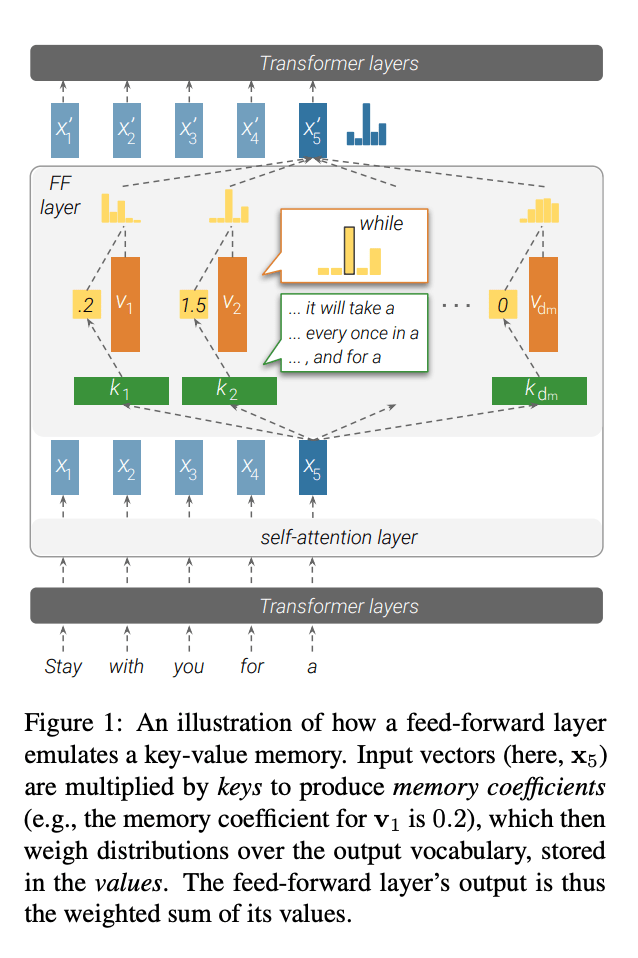
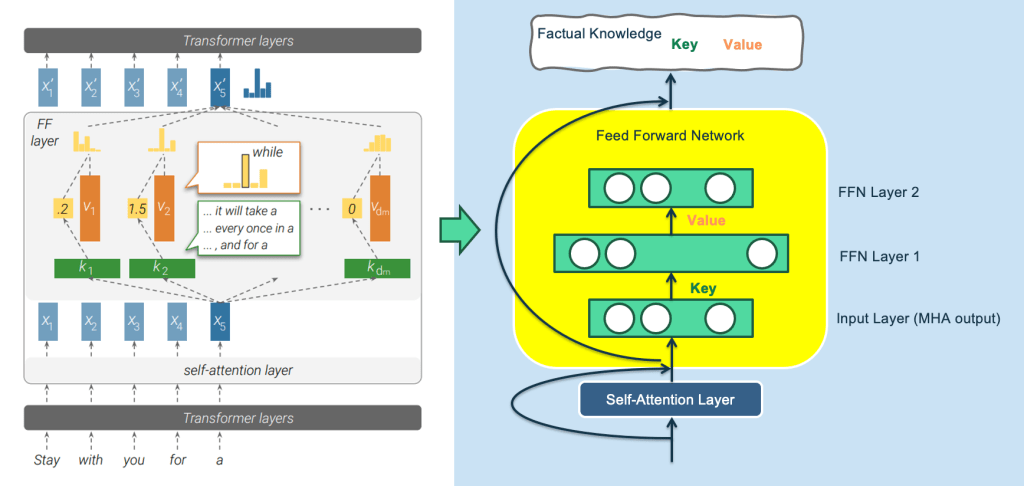
A relatively novel perspective, introduced in the article “Transformer Feed-Forward Layers Are Key-Value Memories,” suggests that the feedforward neural network (FFN) layers in the Transformer architecture function as a Key-Value memory system storing a wealth of specific knowledge. The figure below illustrates this concept, with annotations on the right side for improved clarity (since the original paper’s figure on the left side can be somewhat challenging to grasp).
In this Key-Value memory framework, the first layer of the FFN serves as the Key layer, characterized by a wide hidden layer, while the second layer combines a narrow hidden layer with the Value layer. The input to the FFN layer corresponds to the output embedding generated by the Multi-Head Attention (MHA) mechanism for a specific word, encapsulating the comprehensive context information drawn from the entire input sentence via self-attention.
Each neuron node in the Key layer stores a pair of information. For instance, the node in the first hidden layer of the FFN may record the knowledge.
The Key vector associated with a node essentially acts as a pattern detector, aiming to identify specific language or knowledge patterns within the input. If a relevant pattern is detected, the input vector and the key node’s weight are computed via the vector inner product, followed by the application of the Rectified Linear Unit (ReLU) activation function, signalling that the pattern has been detected. The resulting response value is then propagated to the second FFN layer through the Value weights of the node.
In essence, the FFN’s forward propagation process resembles the detection of a specific knowledge pattern using the Key, retrieving the corresponding Value, and incorporating it into the second FFN layer’s output. As each node in the second FFN layer aggregates information from all nodes in the Key layer, it generates a mixed response, with the collective response across all nodes in the Value layer serving as probability distribution information for the output word.
It may still sound complicated, so let’s use an extreme example to illustrate. We assume that the node in the above figure is the Key-Value memory that records the knowledge. Its Key vector is used to detect the knowledge pattern “The capital of China is…” and its Value. The vector basically stores a vector that is close to the Embedding of the word “Beijing”. When the input of the Transformer is “The capital of China is [Mask]”, the node detects this knowledge pattern from the input layer, so it generates a larger response output. We assume that other neurons in the Key layer have no response to this input, then the corresponding node in the Value layer will actually only receive the word embedding corresponding to the Value “Beijing”, and pass the large response value to perform further numerical calculations. enlarge. Therefore, the output corresponding to the Mask position will naturally output the word “Beijing”. It’s basically this process. It looks complicated, but it’s actually very simple.
Moreover, this article also pointed out that the low-level Transformer responds to the surface pattern of sentences, and the high-level responds to the semantic pattern. That is to say, the low-level FFN stores surface knowledge such as lexicon and syntax, and the middle and high-level layers store semantic and factual concept knowledge. This is consistent with other research The conclusion is consistent.
I would guess that the idea of treating FFN as a Key-Value memory is probably not the final correct answer, but it is probably not too far from the final correct answer.
Knowledge Correction in LLM: Adapting to Evolving Information
As we’ve established that specific pieces of factual knowledge reside in the parameters of one or more feedforward neural network (FFN) nodes within the Large Language Models (LLM), it’s only natural to ponder the feasibility of correcting erroneous or outdated knowledge stored within these models.
Let’s consider an example to illustrate this point. If you were to ask, “Who is the current Prime Minister of the United Kingdom?” in a dynamic political landscape where British Prime Ministers frequently change, would LLM tend to produce “Boris” or “Sunak” as the answer?
In such a scenario, the model is likely to encounter a higher volume of training data containing “Boris.” Consequently, there’s a considerable risk that LLM could provide an incorrect response. Therefore, there arises a compelling need to address the issue of correcting outdated or erroneous knowledge stored within the LLM.
By exploring strategies to rectify knowledge within LLM and adapting it to reflect real-time developments and evolving information, we take a step closer to harnessing the full potential of these models in providing up-to-date and accurate answers to questions that involve constantly changing facts or details. This endeavour forms an integral part of enhancing the reliability and relevance of LLM in practical applications.
Methods for Modifying Knowledge in LLM
Currently, there are three distinctive approaches for modifying knowledge within Large Language Models (LLMs):
Correcting Knowledge at the Source
This method aims to rectify knowledge errors by identifying the specific training data responsible for the erroneous knowledge in the LLM. With advancements in research, it’s possible to trace back the source data that led the LLM to learn a particular piece of knowledge. In practical terms, this means we can identify the training data associated with a specific knowledge item, allowing us to potentially delete or amend the relevant data source. However, this approach has limitations, particularly when dealing with minor knowledge corrections. The need for retraining the entire model to implement even small adjustments can be prohibitively costly. Therefore, this method is better suited for large-scale data removal, such as addressing bias or eliminating toxic content.
Fine-Tuning to Correct Knowledge
This approach involves constructing new training data containing the desired knowledge corrections. The LLM model is then fine-tuned on this data, guiding it to remember new knowledge and forget old knowledge.
While straightforward, it presents challenges, such as the issue of “catastrophic forgetting,” where fine-tuning leads the model to forget not only the targeted knowledge but also other essential knowledge. Given the large size of current LLMs, frequent fine-tuning can be computationally expensive.
Directly Modifying Model Parameters
In this method, knowledge correction is achieved by directly altering the LLM’s model parameters associated with specific knowledge. For instance, if we wish to update the knowledge from “<UK, current Prime Minister, Boris>” to “<UK, current Prime Minister, Sunak>”, we locate the FFN node storing the old knowledge within the LLM parameters.
Subsequently, we forcibly adjust and replace the relevant model parameters within the FFN to reflect the new knowledge. This approach involves two key components: the ability to pinpoint the storage location of knowledge within the LLM parameter space and the capacity to alter model parameters for knowledge correction. Deeper insight into this knowledge revision process contributes to a more profound understanding of LLMs’ internal mechanisms.
These methods provide a foundation for adapting and correcting the knowledge within LLMs, ensuring that these models can produce accurate and up-to-date information in response to ever-changing real-world scenarios.
What’s Next
The next blog is about the Technical Review 03: Scale Effect: What happens when LLM gets bigger and bigger
TL;DR: This blog explores the profound influence of ChatGPT, awakening various sectors – the general public, academia, and industry – to the developmental philosophy of Large Language Models (LLMs). It delves into OpenAI’s prominent role and analyzes the transformative effect of LLMs on Natural Language Processing (NLP) research paradigms. Additionally, it contemplates future prospects for the ideal LLM.
This blog discusses the impact of ChatGPT and the awakening it brought to the understanding of Large Language Models (LLM). It emphasizes the importance of the development philosophy behind LLM and notes OpenAI’s leading position, followed by Google, with DeepMind and Meta catching up. The article highlights OpenAI’s contributions to LLM technology and the global hierarchy in this domain.
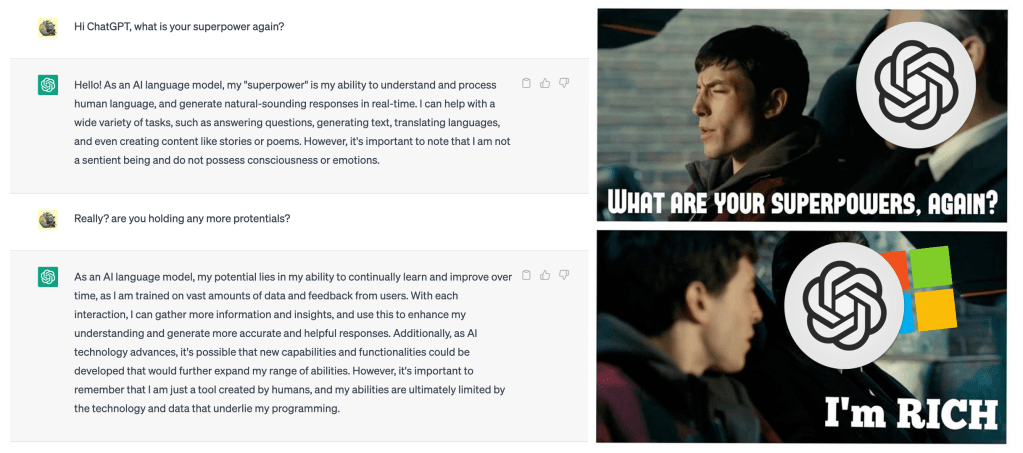
What is Gen-AI’s superpower?
The blog is divided into two main sections: the NLP research paradigm transformation and the ideal Large Language Model (LLM).
In the NLP research paradigm transformation section, there are two significant paradigm shifts discussed. The first shift, from deep learning to two-stage pre-trained models, marked the introduction of models like Bert and GPT. This shift led to the decline of intermediate tasks in NLP and the standardization of technical approaches across different NLP subfields.
The second paradigm shift focuses on the move from pre-trained models to General Artificial Intelligence (AGI). The blog highlights the impact of ChatGPT in bridging the gap between humans and LLMs, allowing LLMs to adapt to human commands and preferences. It also suggests that many independently existing NLP research fields will be incorporated into the LLM technology system, while other fields outside of NLP will also be included. The ultimate goal is to achieve an ideal LLM that is a domain-independent general artificial intelligence model.
In the section on the ideal Large Language Model (LLM), the blog discusses the characteristics and capabilities of an ideal LLM. It emphasizes the self-learning capabilities of LLMs, the ability to tackle problems across different subfields, and the importance of adapting LLMs to user-friendly interfaces. It also mentions the impact of ChatGPT in integrating human preferences into LLMs and the future potential for LLMs to expand into other fields such as image processing and multimodal tasks.
Overall, the blog provides insights into the impact of ChatGPT, the hierarchy in LLM development, and the future directions for LLM technology.
Introduction
Since the emergence of OpenAI ChatGPT, many people and companies have been both surprised and awakened in academia and industry. I was pleasantly surprised because I did not expect a Large Language Model (LLM) to be as effective at this level, and I was also shocked because most of our academic & industrial understanding of LLM and its development philosophy is far from the world’s most advanced ideas. This blog series covers my reviews, reflections, and thoughts about LLM.
From GPT 3.0, LLM is not merely a specific technology; it actually embodies a developmental concept that outlines where LLM should be heading. From a technical standpoint, I personally believe that the main gap exists in the different understanding of LLM and its development philosophy for the future regardless of the financial resources to build LLM.
While many AI-related companies are currently in a “critical stage of survival,” I don’t believe it is as dire as it may seem. OpenAI is the only organization with a forward-thinking vision in the world. ChatGPT has demonstrated exceptional performance that has left everyone trailing behind, even super companies like Google lag behind in their understanding of the LLM development concept and version of their products.
In the field of LLM (Language Model), there is a clear hierarchy. OpenAI is leading internationally, being about six months to a year ahead of Google and DeepMind, and approximately two years ahead of China. Google holds the second position, with technologies like PaLM 1/2, Pathways and Generative AI on GCP Vertex AI, which aligns with their technical vision. These were launched between February and April of 2022, around the same time as OpenAI’s InstructGPT 3.5. This highlights the difference between Google and OpenAI.
DeepMind has mainly focused on reinforcement learning for games and AI in science. They started paying attention to LLM in 2021, and they are currently catching up. Meta AI, previously known as Facebook AI, hasn’t prioritized LLM in the past, but they are now trying to catch up with recently open-sourced Llama 2. These institutions are currently among the best in the field.
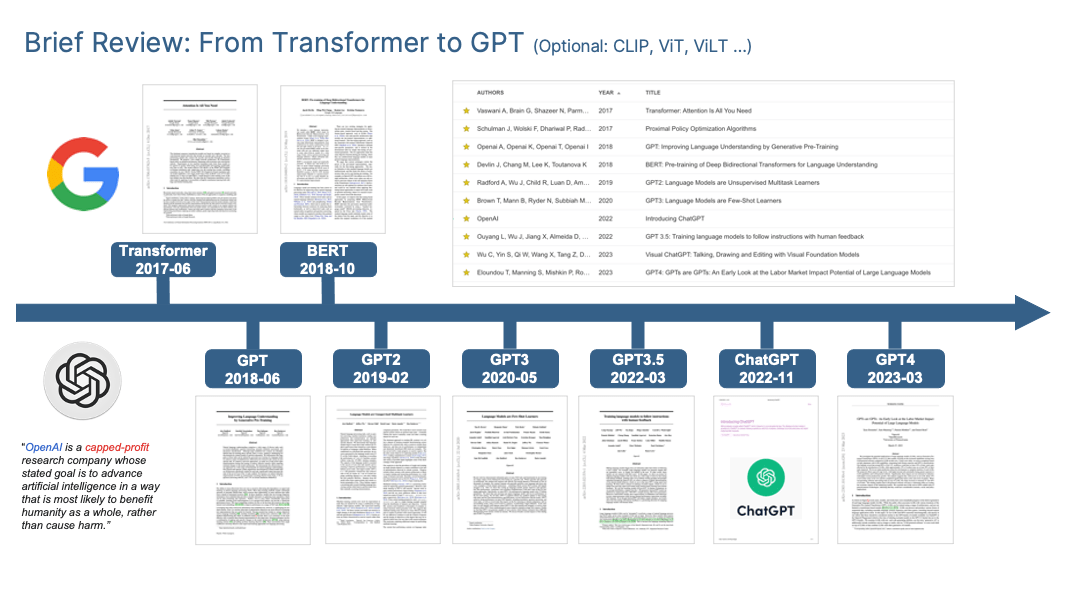
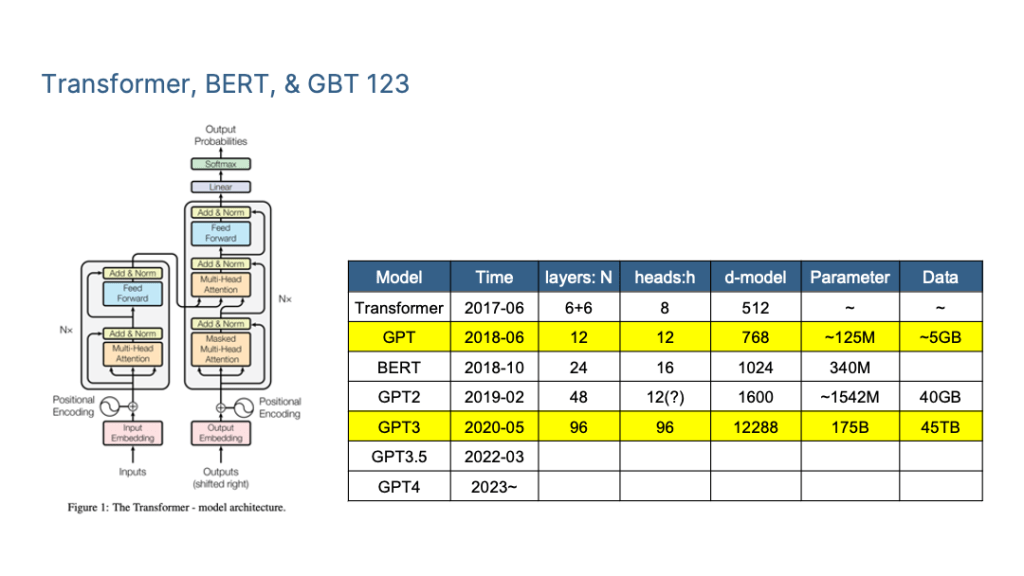
To summarize the mainstream LLM technology I mainly focus on the Transformer, BERT, GPT and ChatGPT <=4.0.
NLP Research Paradigm Transformation
Taking a look back at the early days of deep learning in Natural Language Processing (NLP), we can see significant milestones over the past two decades. There have been two major shifts in the technology of NLP.
Paradigm Shift 1.0 (2013): From Deep Learning to Two-Stage Pre-trained Models
The period of this paradigm shift encompasses roughly the time frame from the introduction of deep learning into the field of NLP, around 2013, up until just before the emergence of GPT 3.0, which occurred around May 2020.
Prior to the rise of models like BERT and GPT, the prevailing technology in the NLP field was deep learning. It was primarily reliant on two core technologies:
A plethora of enhanced LSTM models and a smaller number of improved ConvNet models served as typical Feature Extractors.
A prevalent technical framework for various specific tasks was based on Sequence-to-Sequence (or Encoder-Decoder) Architectures coupled with Attention mechanisms.
With these foundational technologies in place, the primary research focus in deep learning for NLP revolved around how to effectively increase model depth and parameter capacity. This involved the continual addition of deeper LSTM or CNN layers to encoders and decoders with the aim of enhancing layer depth and model capacity. Despite these efforts successfully deepening the models, their overall effectiveness in solving specific tasks was somewhat limited. In other words, the advantages gained compared to non-deep learning methods were not particularly significant.
The difficulties that have held back the success of deep learning in NLP can be attributed to two main issues:
Scarcity of Training Data: One significant challenge is the lack of enough training data for specific tasks. As the model becomes more complex, it requires more data to work effectively. This used to be a major problem in NLP research before the introduction of pre-trained models.
Limited Ability of LSTM/CNN Feature Extractors: Another issue is that the feature extractors using LSTM/CNN are not versatile enough. This means that, no matter how much data you have, the model struggles to make good use of it because it can’t effectively capture and utilize the information within the data.
These two factors seem to be the primary obstacles that have prevented deep learning from making significant advancements in the field of NLP.
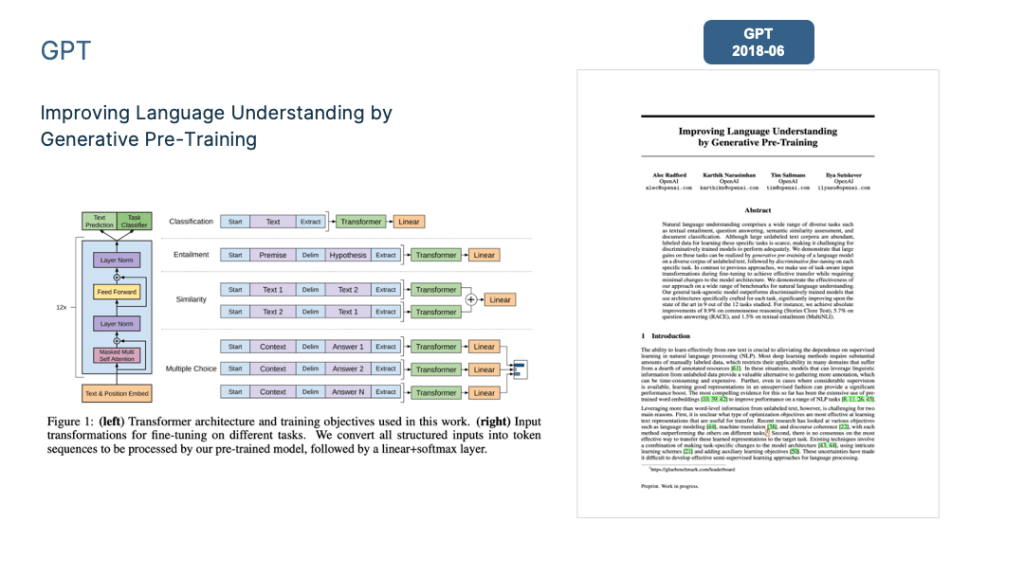
The advent of two pre-training models, Bert and GPT, marks a significant technological advancement in the field of NLP.
About a year after the introduction of Bert, the technological landscape had essentially consolidated into these two core models.
This development has had a profound impact on both academic research and industrial applications, leading to a complete transformation of the research paradigm in the field. The impact of this paradigm shift can be observed in two key areas:
firstly, a decline and, in some cases, the gradual obsolescence of certain NLP research subfields;
secondly, the growing standardization of technical methods and frameworks across different NLP subfields.
Impact 1: The Decline of Intermediate Tasks
In the field of NLP, tasks can be categorized into two major groups: “intermediate tasks” and “final tasks.”
Intermediate tasks, such as word segmentation, part-of-speech tagging, and syntactic analysis, don’t directly address real-world needs but rather serve as preparatory stages for solving actual tasks. For example, the user doesn’t require a syntactic analysis tree; they just want an accurate translation.
In contrast, “final tasks,” like text classification and machine translation, directly fulfil user needs.
Intermediate tasks initially arose due to the limited capabilities of early NLP technology. Researchers segmented complex problems like Machine Translation into simpler intermediate stages because tackling them all at once was challenging. However, the emergence of Bert/GPT has made many of these intermediate tasks obsolete. These models, through extensive pre-training on data, have incorporated these intermediate tasks as linguistic features within their parameters. As a result, we can now address final tasks directly, without modelling these intermediary processes.
Even Chinese word segmentation, a potentially controversial example, follows the same principle. We no longer need to determine which words should constitute a phrase; instead, we let Large Language Models (LLM) learn this as a feature. As long as it contributes to task-solving, LLM will naturally grasp it. This may not align with conventional human word segmentation rules.
In light of these developments, it’s evident that with the advent of Bert/GPT, NLP intermediate tasks are gradually becoming obsolete.
Impact 2: Standardization of Technical Approaches Across All Areas
Within the realm of “final tasks,” there are essentially two categories: natural language understanding tasks and natural language generation tasks.
Natural language understanding tasks, such as text classification and sentiment analysis, involve categorizing input text.
In contrast, natural language generation tasks encompass areas like chatbots, machine translation, and text summarization, where the model generates output text based on input.
Since the introduction of the Bert/GPT models, a clear trend towards technical standardization has emerged.
Firstly, feature extractors across various NLP subfields have shifted from LSTM/CNN to Transformer. The writing was on the wall shortly after Bert’s debut, and this transition became an inevitable trend.
Currently, Transformer not only unifies NLP but is also gradually supplanting other models like CNN in various image processing tasks. Multi-modal models have similarly adopted the Transformer framework. This Transformer journey, starting in NLP, is expanding into various AI domains, kickstarted by the Vision Transformer (ViT) in late 2020. This expansion shows no signs of slowing down and is likely to accelerate further.
Secondly, most NLP subfields have adopted a two-stage model: model pre-training followed by application fine-tuning or Zero/Few Shot Prompt application.
To be more specific, various NLP tasks have converged into two pre-training model frameworks:
For natural language understanding tasks, the “bidirectional language model pre-training + application fine-tuning” model represented by Bert has become the standard.
For natural language generation tasks, the “autoregressive language model (i.e., one-way language model from left to right) + Zero/Few Shot Prompt” model represented by GPT 2.0 is now the norm.
Though these models may appear similar, they are rooted in distinct development philosophies, leading to divergent future directions. Regrettably, many of us initially underestimated the potential of GPT’s development route, instead placing more focus on Bert’s model.
Paradigm Shift 2.0 (2020): Moving from Pre-Trained Models to General Artificial Intelligence (AGI)
This paradigm shift began around the time GPT 3.0 emerged, approximately in June 2020, and we are currently undergoing this transition.
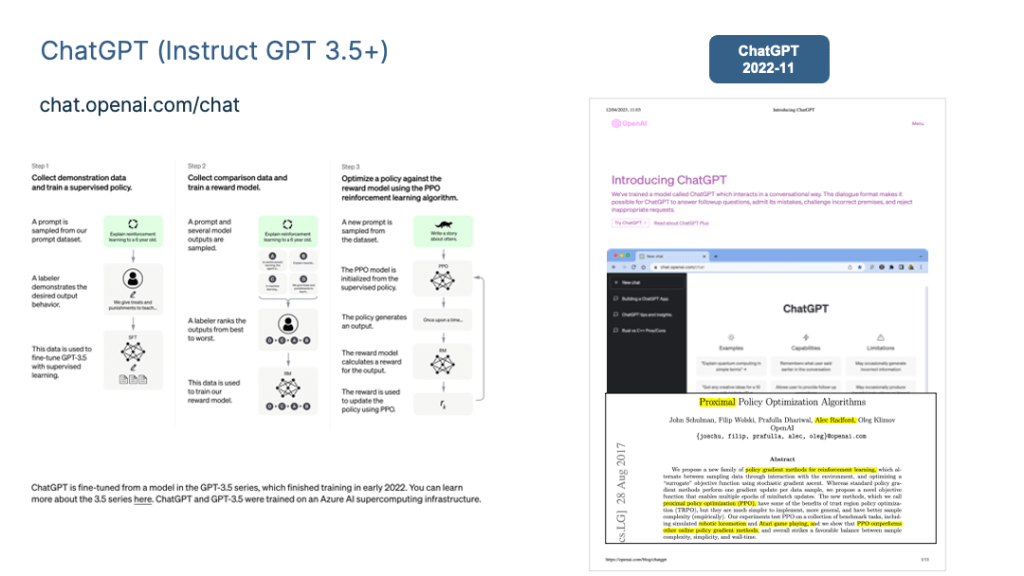
ChatGPT served as a pivotal point in initiating this paradigm shift. However, before the appearance of InstructGPT, Large Language Models (LLM) were in a transitional phase.
Transition Period: Dominance of the “Autoregressive Language Model + Prompting” Model as Seen in GPT 3.0
As mentioned earlier, during the early stages of pre-training model development, the technical landscape primarily converged into two distinct paradigms: the Bert mode and the GPT mode. Bert was the favoured path, with several technical improvements aligning with that direction. However, as technology progressed, we observed that the largest LLM models currently in use are predominantly based on the “autoregressive language model + Prompting” model, similar to GPT 3.0. Models like GPT 3, PaLM, GLaM, Gopher, Chinchilla, MT-NLG, LaMDA, and more all adhere to this model, without exceptions.
Why has this become the prevailing trend? There are likely two key reasons driving this shift, and I believe they are at the forefront of this transition.
Firstly, Google’s T5 model plays a crucial role in formally uniting the external expressions of both natural language understanding and natural language generation tasks. In the T5 model, tasks that involve natural language understanding, like text classification and determining sentence similarity (marked in red and yellow in the figure above), align with generation tasks in terms of input and output format.
This means that classification tasks can be transformed within the LLM model to generate corresponding category strings, achieving a seamless integration of understanding and generation tasks. This compatibility allows natural language generation tasks to harmonize with natural language understanding tasks, a feat that would be more challenging to accomplish the other way around.
The second reason is that if you aim to excel at zero-shot prompting or few-shot prompting, the GPT mode is essential.
Now, recent studies, as referenced in “On the Role of Bidirectionality in Language Model Pre-Training,” demonstrate that when downstream tasks are resolved during fine-tuning, the Bert mode outperforms the GPT mode. Conversely, if you employ zero-shot or few-shot prompting to tackle downstream tasks, the GPT mode surpasses the Bert mode.
But this leads to an important question: Why do we strive to use zero-shot or few-shot prompting for task completion? To answer this question, we first need to address another: What type of Large Language Model (LLM) is the most ideal for our needs?
The Ideal Large Language Model (LLM)
The image above illustrates the characteristics of an ideal Large Language Model (LLM). Firstly, the LLM should possess robust self-learning capabilities. When fed with various types of data such as text and images from the world, it should autonomously acquire the knowledge contained within. This learning process should require no human intervention, and the LLM should be adept at flexibly applying this knowledge to address real-world challenges. Given the vastness of the data, this model will naturally be substantial in size, a true giant model.
Secondly, the LLM should be capable of tackling problems across any subfield of Natural Language Processing (NLP) and extend its capabilities to domains beyond NLP. Ideally, it should proficiently address queries from any discipline.
Moreover, when we utilize the LLM to resolve issues in a particular field, the LLM should understand human commands and use expressions that align with human conventions. In essence, it should adapt to humans, rather than requiring humans to adapt to the LLM model.
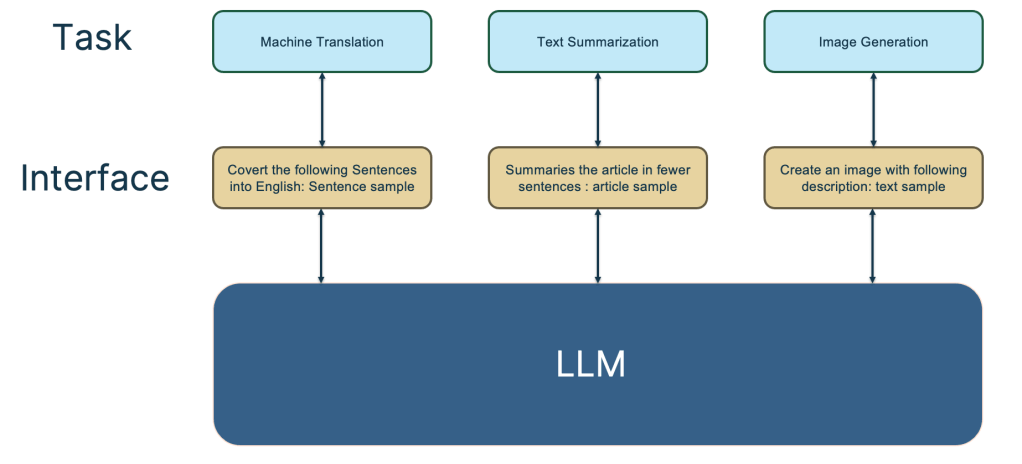
A common example of people adapting to LLM is the need to brainstorm and experiment with various prompts in order to find the best prompts for a specific problem. In this context, the figure above provides several examples at the interface level where humans interact with the LLM, illustrating the ideal interface design for users to effectively utilize the LLM model.
Now, let’s revisit the question: Why should we pursue zero-shot/few-shot prompting to complete tasks? There are two key reasons:
The Enormous Scale of LLM Models: Building and modifying LLM models of this scale requires immense resources and expertise, and very few institutions can undertake this. However, there are numerous small and medium-sized organizations and even individuals who require the services of such models. Even if these models are open-sourced, many lack the means to deploy and fine-tune them. Therefore, an approach that allows task requesters to complete tasks without tweaking the model parameters is essential. In this context, prompt-based methods offer a solution to fulfil tasks without relying on fine-tuning (note that soft prompting deviates from this trend). LLM model creators aim to make LLM a public utility, operating it as a service. To accommodate the evolving needs of users, model producers must strive to enable LLM to perform a wide range of tasks. This objective is a byproduct and a practical reason why large models inevitably move toward achieving General Artificial Intelligence (AGI).
The Evolution of Prompting Methods: Whether it’s zero-shot prompting, few-shot prompting, or the more advanced Chain of Thought (CoT) prompting that enhances LLM’s reasoning abilities, these methods align with the technology found in the interface layer illustrated earlier. The original aim of zero-shot prompting was to create the ideal interface between humans and LLM, using the task expressions that humans are familiar with. However, it was found that LLM struggled to understand and perform well with this approach. Subsequent research revealed that when a few examples were provided to represent the task description, LLM’s performance improved, leading to the exploration of better few-shot prompting technologies. In essence, our initial hope was for LLM to understand and execute tasks using natural, human-friendly commands. However, given the current technological limitations, these alternative methods have been adopted to express human task requirements.
Understanding this logic, it becomes evident that few-shot prompting, also known as In Context Learning, is a transitional technology. When we can describe a task more naturally and LLM can comprehend it, we will undoubtedly abandon these transitional methods. The reason is clear: using these approaches to articulate task requirements does not align with human habits and usage patterns.
This is also why I classify GPT 3.0+Prompting as a transitional technology. The arrival of ChatGPT has disrupted this existing state of affairs by introducing Instruct instead of Prompting. This change marks a new technological paradigm shift and has subsequently led to several significant consequences.
Impact 1: LLM Adapting Humans NEEDS with Natural Interfaces
In the context of an ideal LLM, let’s focus on ChatGPT to grasp its technical significance. ChatGPT stands out as one of the technologies that align most closely with the ideal LLM, characterized by its remarkable attributes: “Powerful and considerate.”
This “powerful capability” can be primarily attributed to the foundation provided by the underlying LLM, GPT 3.5, on which ChatGPT relies. While ChatGPT includes some manually annotated data, the scale is relatively small, amounting to tens of thousands of examples. In contrast, GPT 3.5 was trained on hundreds of billions of token-level data, making this additional data negligible in terms of its contribution to the vast wealth of world knowledge and common sense already embedded in GPT 3.5. Hence, ChatGPT’s power primarily derives from the GPT 3.5 model, which sets the benchmark for the ideal LLM models.
But does ChatGPT infuse new knowledge into the GPT 3.5 model? Yes, it does, but this knowledge isn’t about facts or world knowledge; it’s about human preferences. “Human preference” encompasses a few key aspects:
First and foremost, it involves how humans naturally express tasks. For instance, humans typically say, “Translate the following sentence from Chinese to English” to convey the need for “machine translation.” But LLMs aren’t humans, so understanding such commands is a challenge. To bridge this gap, ChatGPT introduces this knowledge into GPT 3.5 through manual data annotation, making it easier for the LLM to comprehend human commands. This is what empowers ChatGPT with “empathy.”
Secondly, humans have their own standards for what constitutes a good or bad answer. For example, a detailed response is deemed good, while an answer containing discriminatory content is considered bad. The feedback data that people provide to LLM through the Reward Model embodies this quality preference. In essence, ChatGPT imparts human preference knowledge to GPT 3.5, resulting in an LLM that comprehends human language and is more polite.
The most significant contribution of ChatGPT is its achievement of the interface layer of the ideal LLM. It allows the LLM to adapt to how people naturally express commands, rather than requiring people to adapt to the LLM’s capabilities and devise intricate command interfaces. This shift enhances the usability and user experience of LLM.
It was InstructGPT/ChatGPT that initially recognized this challenge and offered a viable solution. This is also their most noteworthy technical contribution. In comparison to prior few-shot prompting methods, it is a human-computer interface technology that aligns better with human communication habits for interacting with LLM.
This achievement is expected to inspire subsequent LLM models and encourage further efforts in creating user-friendly human-computer interfaces, ultimately making LLM more responsive to human needs.
Impact 2: Many NLP subfields no longer have independent research value
In the realm of NLP, this paradigm shift signifies that many independently existing NLP research fields will be incorporated into the LLM technology framework, gradually losing their independent status and fading away. Following the initial paradigm shift, while numerous “intermediate tasks” in NLP are no longer required as independent research areas, most of the “final tasks” remain and have transitioned to a “pre-training + fine-tuning” framework, sparking various improvement initiatives to tackle specific domain challenges.
Current research demonstrates that for many NLP tasks, as the scale of LLM models increases, their performance significantly improves. From this, one can infer that many of the so-called “unique” challenges in a given field likely stem from a lack of domain knowledge. With sufficient domain knowledge, these seemingly field-specific issues can be effectively resolved. Thus, there’s often no need to focus intensely on field-specific problems and devise specialized solutions. The path to achieving AGI might be surprisingly straightforward: provide more data in a given field to the LLM and let it autonomously accumulate knowledge.
In this context, ChatGPT proves that we can now directly pursue the ideal LLM model. Therefore, the future technological trend should involve the pursuit of ever-larger LLM models by expanding the diversity of pre-training data, allowing LLMs to independently acquire domain-specific knowledge through pre-training. As the model scale continues to grow, numerous problems will be addressed, and the research focus will shift to constructing this ideal LLM model rather than solving field-specific problems. Consequently, more NLP subfields will be integrated into the LLM technology system and gradually phase out.
In my view, the criteria for determining whether independent research in a specific field should cease can be one of the following two methods:
First, assess whether the LLM’s research performance surpasses human performance for a particular task. For fields where LLM outperforms humans, there is no need for independent research. For instance, for many tasks within the GLUE and SuperGLUE test sets, LLMs currently outperform humans, rendering independently existing research fields closely associated with these datasets unnecessary.
Second, compare task performance between the two modes. The first mode involves fine-tuning with extensive domain-specific data, while the second mode employs few-shot prompting or instruct-based techniques. If the second mode matches or surpasses the performance of the first, it indicates that the field no longer needs to exist independently. By this standard, many research fields currently favour fine-tuning (due to the abundance of training data), seemingly justifying their independent existence. However, as models grow in size, the effectiveness of few-shot prompting continues to rise, and it’s likely that this turning point will be reached in the near future.
If these speculations hold true, it presents the following challenging realities:
For many NLP researchers, they must decide which path to pursue. Should they persist in addressing field-specific challenges?
Or should they abandon what may seem like a less promising route and instead focus on constructing a superior LLM?
If the choice is to invest in LLM development, which institutions possess the ability and resources to undertake this endeavour?
What’s your response to this question?
Impact 3: More research fields other than NLP will be included in the LLM technology system
From the perspective of AGI, referring to the ideal LLM model described previously, the tasks it can complete should not be limited to the NLP field or one or two subject areas. The ideal LLM should be a domain-independent general artificial intelligence model. , it is now doing well in one or two fields, but it does not mean that it can only do these tasks.
The emergence of ChatGPT proves that it is feasible for us to pursue AGI in this period, and now is the time to put aside the shackles of “field discipline” thinking.
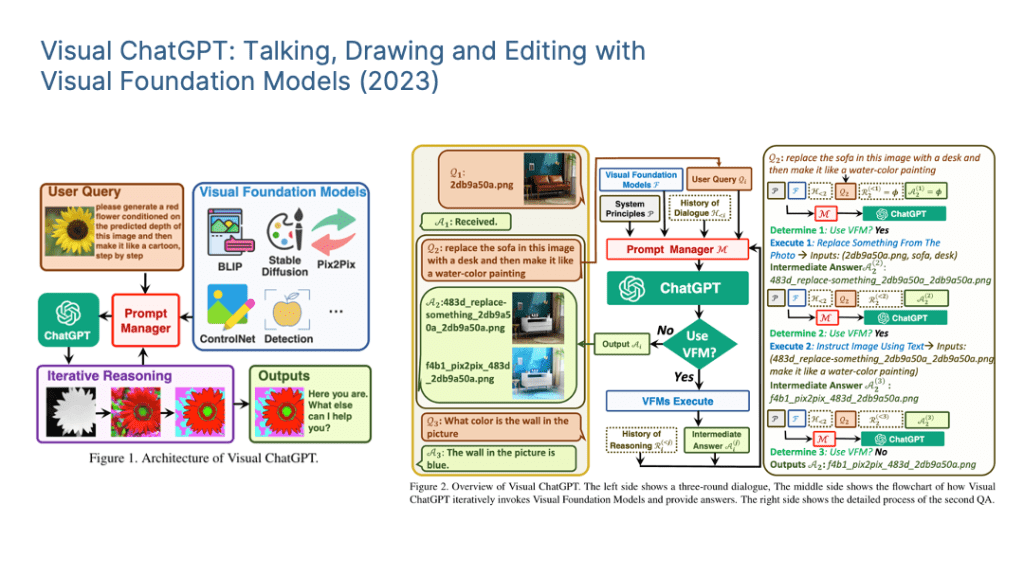
In addition to demonstrating its ability to solve various NLP tasks in a smooth conversational format, ChatGPT also has powerful coding capabilities. Naturally, more and more other research fields will be gradually included in the LLM system and become part of general artificial intelligence.
LLM expands its field from NLP to the outside world. A natural choice is image processing and multi-modal related tasks. There are already some efforts to integrate multimodality and make LLM a universal human-computer interface that supports multimodal input and output. Typical examples include DeepMind’s Flamingo and Microsoft’s “Language Models are General-Purpose Interfaces”, as shown above. The conceptual structure of this approach is demonstrated.
My judgment is that whether it is images or multi-modality, the future integration into LLM to become useful functions may be slower than we think.
The main reason is that although the image field has been imitating Bert’s pre-training approach in the past two years, it is trying to introduce self-supervised learning to release the model’s ability to independently learn knowledge from image data. Typical technologies are “contrastive learning” and MAE. These are two different technical routes.
However, judging from the current results, despite great technological progress, it seems that this road has not yet been completed. This is reflected in the application of pre-trained models in the image field to downstream tasks, which brings far fewer benefits than Bert or GPT. The application is significant in NLP downstream tasks.
Therefore, image preprocessing models still need to be explored in depth to unleash the potential of image data, which will delay their unification into large LLM models. Of course, if this road is opened one day, there is a high probability that the current situation in the field of NLP will be repeated, that is, various research subfields of image processing may gradually disappear and be integrated into large-scale LLM to directly complete terminal tasks.
In addition to images and multi-modality, it is obvious that other fields will gradually be included in the ideal LLM. This direction is in the ascendant and is a high-value research topic.
The above are my personal thoughts on paradigm shift. Next, let’s sort out the mainstream technological progress of the LLM model after GPT 3.0.
As shown in the ideal LLM model, related technologies can actually be divided into two major categories;
One category is about how the LLM model absorbs knowledge from data and also includes the impact of model size growth on LLM’s ability to absorb knowledge;
The second category is about human-computer interfaces about how people use the inherent capabilities of LLM to solve tasks, including In Context Learning and Instruct modes. Chain of Thought (CoT) prompting, an LLM reasoning technology, essentially belongs to In Context Learning. Because they are more important, I will talk about them separately.
2. Openai, A. R., Openai, K. N., Openai, T. S. & Openai, I. S. GPT: Improving Language Understanding by Generative Pre-Training. (2018).
3. Devlin, J., Chang, M.-W., Lee, K. & Toutanova, K. BERT: Pre-training of Deep Bidirectional Transformers for Language Understanding. (2018).
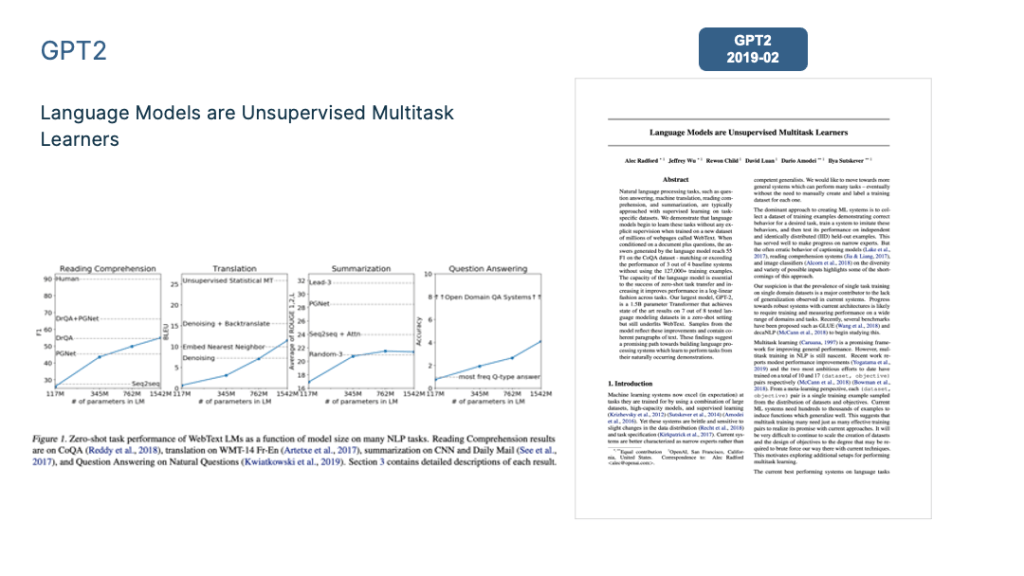
4. Radford, A. et al. GPT2: Language Models are Unsupervised Multitask Learners. (2019).
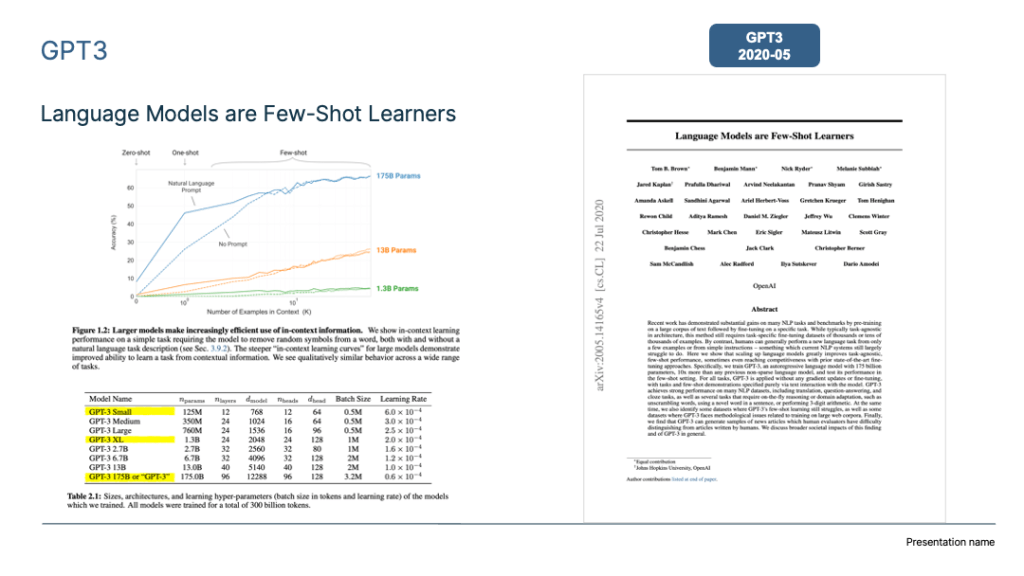
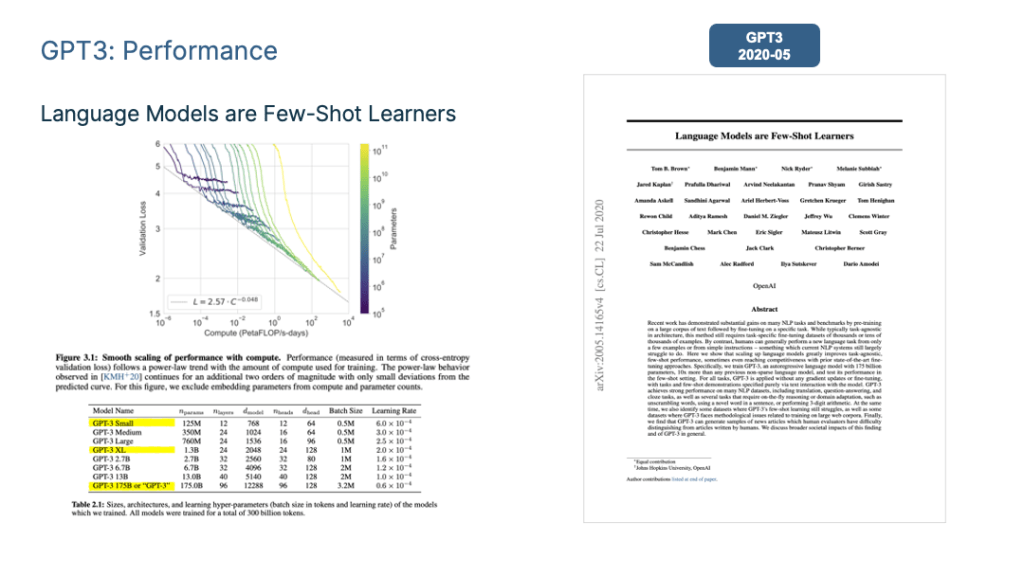
5. Brown, T. B. et al. GPT3: Language Models are Few-Shot Learners. (2020).
6. Ouyang, L. et al. GPT 3.5: Training language models to follow instructions with human feedback. (2022).
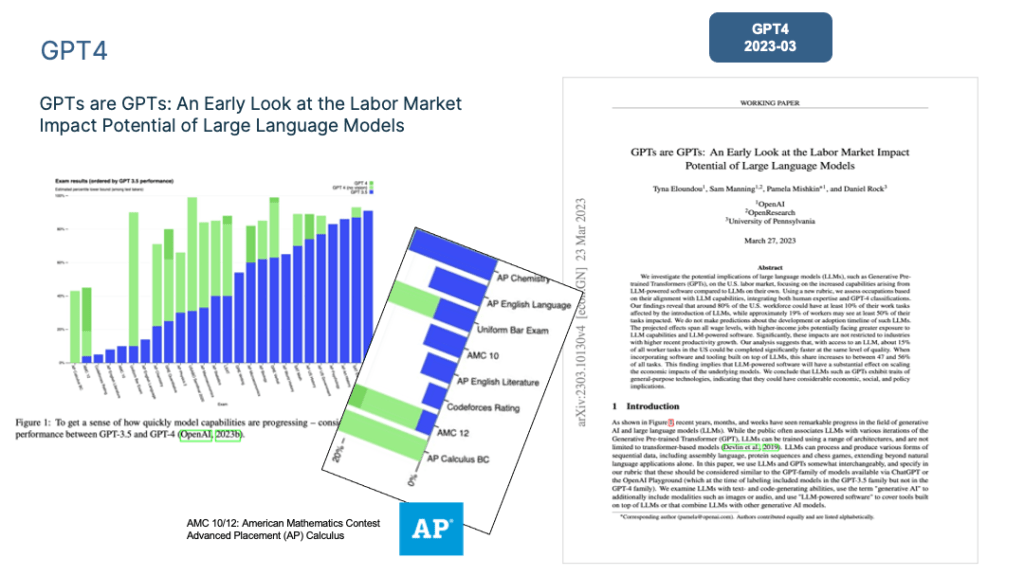
7. Eloundou, T., Manning, S., Mishkin, P. & Rock, D. GPT4: GPTs are GPTs: An Early Look at the Labor Market Impact Potential of Large Language Models. (2023).
[2023-06 Update Review]: add more details about related terms for better understanding.
In this blog, I will review the Classic Technical Framework of the modern (Deep Learning) recommendation system (aka. recommender system).
Before Starting
Before I start, I want to ask readers a question:
What is the first thing you want to do when you start learning a new field X?
Of course, everyone has their own answers, but for me, there are two questions I want to know the most at the beginning. Here X is the recommender system.
What problem is this X trying to solve?
Is there a high-level mind map so that I can understand the basic concepts, main technologies and development requirements in this X?
Moreover, for the field of “deep learning recommendation system”, there may be a third question.
Why do people keep emphasizing “deep learning“, and what revolutionary impact does deep learning bring to the recommendation system?
I hope you will find answers to these three questions after reading this blog.
What is the fundamental problem to be solved by a recommender system?
The applications of recommender systems have gotten into all aspects of life, such as shopping, entertainment, and learning. Although the recommendation scenarios such as product recommendation, video recommendation, and news recommendation may be completely different, since they are all called “recommender systems”, the essential problem to be solved must be the same and follow a common logical framework.
The problem to be solved by the recommender system can be summed up in one sentence:
In the information overload era, how can Users efficiently obtain the Items of their interest?
Therefore, the recommendation system is a bridge built between “the overloaded Internet information” and “users’ interests“.
Let’s look at the recommender system’s abstract logical architecture, and then build its technical architecture step by step, so you can have an overall impression of the entire system.
The logical architecture of the recommender system
Starting from the fundamental problem of the recommendation system, we can clearly see that the recommendation system is actually dealing with the relationship between “people” and “information“. That is, based on “people” and “information” to construct a method of finding interesting information for the people.
User – From the perspective of “people“, in order to more reliably infer the interests of “people”, the recommender system hopes to use a large amount of information related to “people”, including historical behaviour, population attributes, relationship networks, etc. They may be collectively referred to as “User Information“.
Item – The definition of “information” has specific meanings and diverse interpretations in different scenarios. For example, it refers to “product information” in product recommendations, “video information” in video recommendations, and “news information” in news recommendations. We can collectively refer to them as “Item Information” for convenience.
Content – In addition, in a specific recommendation scenario, the user’s final selection is generally affected by a series of environmental information such as time, location, and user status, which can also be called “scene information” or “context information”.
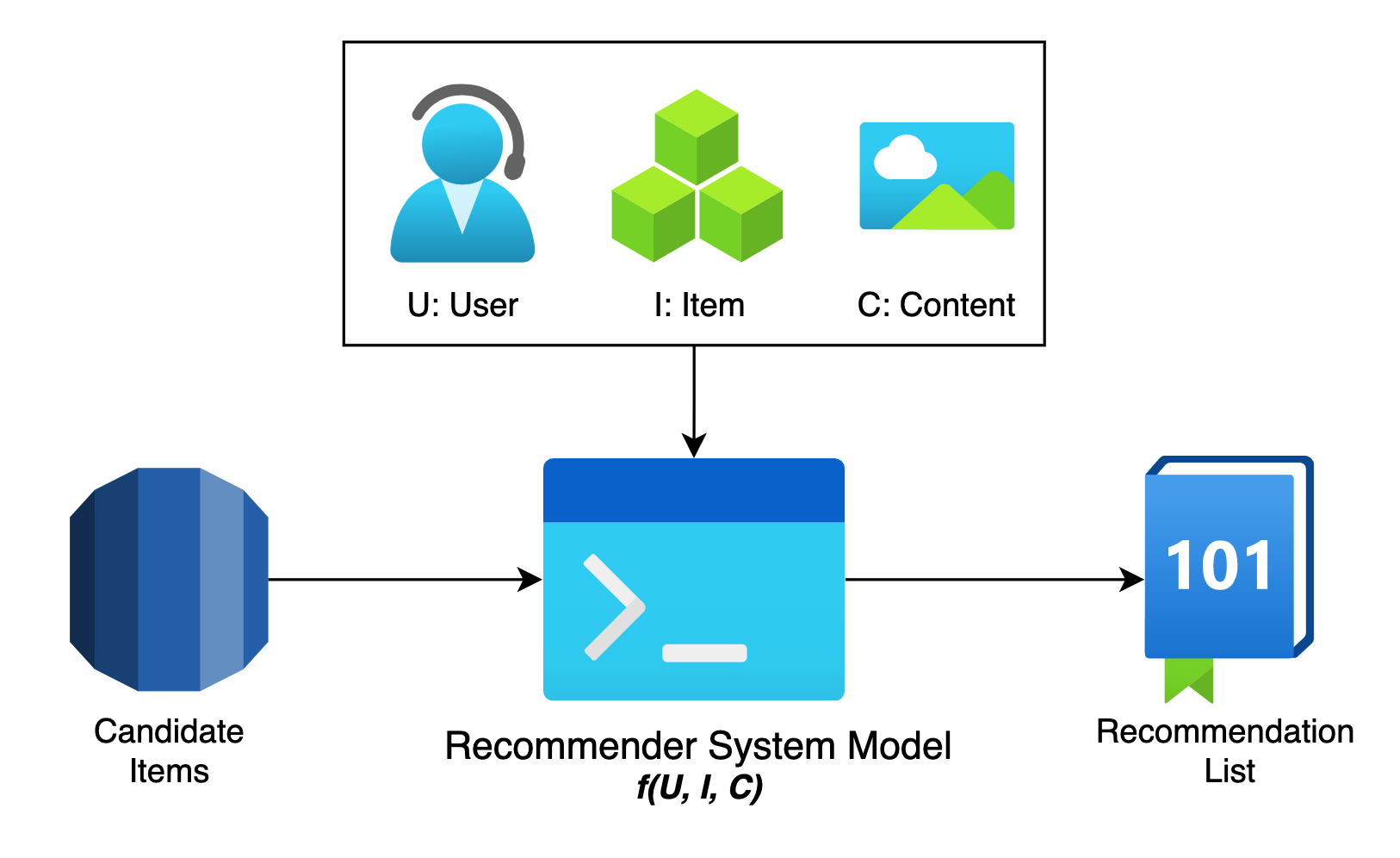
With these definitions, the problem to be dealt with by the recommender system can be formally defined as:
For a certain user U (User), in a specific scenario C (Context), build a function for massive “item” information, predict the user’s preference for a specific candidate item I (Item), and then sort all candidate items according to the preference to generate a recommendation list.
In this way, we can abstract the logical framework of the recommender system, as shown in Figure 1. Although this logical framework is relatively simple, it is on this simple basis that we can refine and expand each module to produce the entire technical system.
Figure 1. The logical architecture diagram of the recommender system includes the Candidate Item, the Recommender System Model of the User, the Item and Content, and the final Recommendation List.
The Revolution of Deep Learning for Recommender Systems
With the logical architecture of the recommender system (Figure 1), we can answer the third question from the beginning:
“What revolutionary impact does deep learning bring to the recommender system?“
In the logic architecture diagram, the central position is an abstract function f(U, I, C), which is responsible for “guessing” the user’s heart and “scoring” the items that the user may be interested in so as to obtain the final recommended item list. In the recommender system, this function is generally referred to as the “recommendation system model” (hereinafter referred to as the “recommendation model“).
The application of deep learning to recommendation systems can greatly enhance the fitting and expressive capabilities of recommendation models. Simply put, deep learning aims to make the recommendation model “guess more accurately” and better capture the “heart” of users.
So you may still not have a clear concept. Next, let’s compare the difference between the traditional machine learning recommendation model and the deep learning recommendation model from the perspective of the model structure so that you can have a clearer understanding.
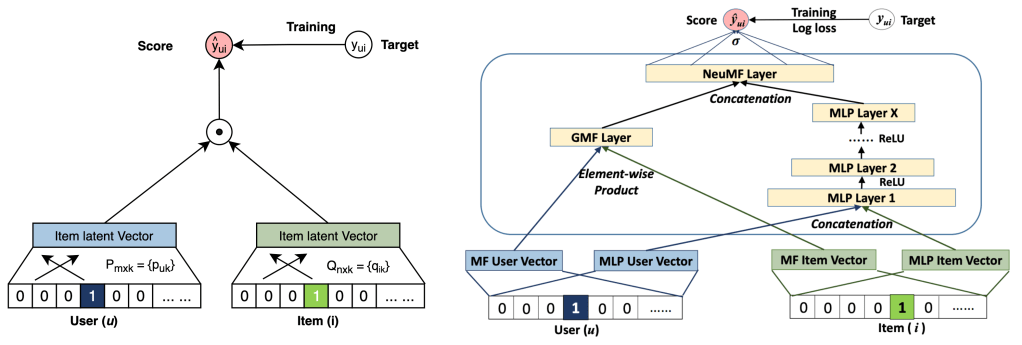
Here is a model structure comparison chart in Figure 2, which compares the difference between the traditional Matrix Factorization model and the Deep Learning Matrix Factorization model.
Figure 2. Traditional Matrix Factorization model vs Deep Learning Matrix Factorization model (Neural collaborative filtering). Source: https://arxiv.org/abs/1708.05031
Let’s ignore the details for now. How do you feel at first glance?
Do you feel that the deep learning model has become more complex, layer after layer, and the number of layers has increased a lot?
In addition, the flexible model structure of the deep learning model also gives it an irreplaceable advantage; that is, we can let the neural network of the deep learning model simulate the changing process of many user interests and even the thinking process of the user making a decision.
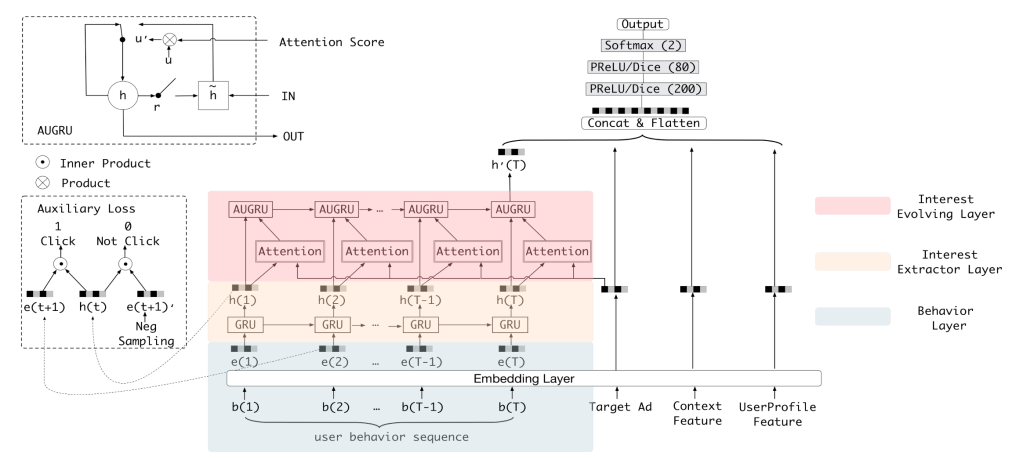
For example, Alibaba‘s deep learning model, Deep Interest Evolution Network (Figure 3 DIEN), uses the structure of a three-layer sequence model to simulate the process of users’ interest evolution when purchasing goods, while such a powerful data fitting ability to interpret user behaviour is not available in traditional machine learning models.
Figure 3. Alibaba’s Deep Interest Evolution Network (DIEN) for Click-Through Rate (CTR) Prediction. AUGRU (GRU with attentional update gate) models the interest-evolving process that is relative to the target item. GRU denotes Gated Recurrent Units, which overcomes the vanishing gradients problem of RNN and is faster than LSTM. Source: https://arxiv.org/abs/1809.03672.
Moreover, the revolutionary impact of deep learning on recommender systems goes far beyond that. In recent years, due to the greatly increased structural complexity of deep learning models, more and more data streams are required to converge for the model training, testing and serving. The data storage, processing and updating modules related to the recommender systems on the cloud computing platforms have also entered the “deep learning era”.
After talking so much about the impact of deep learning on recommender systems, we seem to have not seen a complete deep learning recommender system architecture. Don’t worry. Let’s talk about what the technical architecture of a classic deep-learning recommender system looks like in the next section.
Technical Architecture of Deep Learning Recommendation System
The architecture of the deep learning recommender system is in the same line as the classic one. It improves some specific modules of the classic architecture to enable and support the application of deep learning. So, I will first talk about the classic recommender system architecture and then talk about deep learning and its improvements.
In the actual recommender system, there are two types of problems that engineers need to focus on in projects.
Type 1 is about data and information. What are “user information”, “item information”, and “scenario information”? How to store, update and process these data?
Type 2 is on recommendation algorithms and models. How to train, predict, and achieve better recommendation results for the system?
An industrial recommendation system’s technical architecture is based on these two parts.
The “data and information” part has gradually developed into a data flow framework that integrates offline (nearline) batch processing of data and real-time stream processing in the recommender system.
The “model and algorithm” part is further refined into a model framework that integrates training, evaluation, deployment, and online inference in the recommender system.
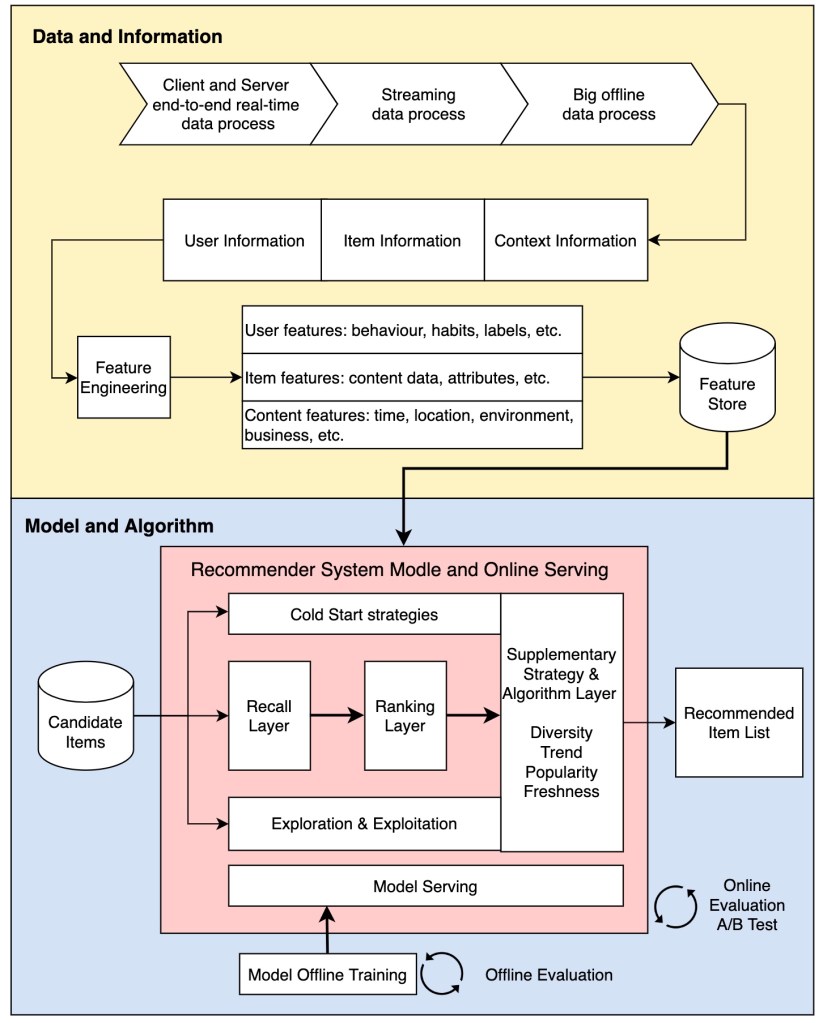
Based on this, we can summarize the technical architecture diagram of the recommender system as in Figure 4.
Figure 4. Diagram of the technical architecture of the recommendation system
In Figure 4, I divided the technical architecture of the recommender system into a “data part” and a “model part”.
Part 1: Data Framework
The “data part” of the recommender system is mainly responsible for the collection and processing of “user“, “item” and “content” information. Based on the difference in the amount of data and the real-time processing requirements, we use three different data processing methods sorted by order of real-time performance, they are:
Client and Server end-to-end real-time data processing.
Real-time stream data processing.
Big data offline processing.
From 1 to 3, the real-time performance of these methods decreases from strong to weak, and the massive data processing capabilities of the three methods increase from weak to strong.
Method
Real-Time Performance
Data Processing Capability
Possible Solutions
Client and Server end-to-end real-time data processing
Strong
Weak
Flink
Real-time stream data processing
Medium
Medium
…
Big data offline processing
Weak
Strong
Spark
Therefore, the data flow system of a mature recommender system will complement each other and use them together.
The big data computing platform (e.g., AWS, Azure, GCP, etc.) of the recommender system can extract training data, feature data, and statistical data through the processing of the system logs and metadata of items and users. So what are these data for?
Specifically, there are three downstream applications based on the data exported from the data platform:
Generate the Sample Data required by the recommender system model for the training and evaluation of the algorithm model.
Generate “user features“, “item features” and a part of “content features” required by the recommendation system model service (Model Serving) for online inference.
Generate statistical data required for System Monitoring and Business Intelligence (BI) systems.
The data part is the “water source” of the entire recommender system. Only by ensuring the continuity and purity of the “water source” can we continuously “nourish” the recommender system so that it can operate efficiently and output accurately.
In the deep learning era, models have higher requirements for “water sources”. First of all, the amount of water must be large. Only in this way can we ensure that the deep learning models we build can converge as soon as possible; Secondly, the “water flow” should be fast so that the data can flow to the system modules for model updates and adjustments. Thus, the model can grasp the changes in user interest in real time. This is the same reason causing the rapid development and application of big data engine (Spark) and the stream computing platform (Flink).
Part II: Model Framework
The “model part” is the major body of the recommender system. The structure of the model is generally composed of a “recall layer“, a “ranking layer”, and a “supplementary (auxiliary) strategy and algorithm layer“.
The “recall layer” is generally composed of efficient recall rules, algorithms or simple models, which allow the recommender system to quickly recall items that users may be interested in from a massive candidate set.
The “ranking layer” uses the ranking/sorting model(s) to fine-sort-rank the candidate items that are initially screened by the recall layer.
The “supplementary strategy and algorithm layer“, also known as the “re-ranking layer“, is a combination of some supplements to take into account indicators such as “diversity“, “popularity” and “freshness” of the results before returning to the user recommendation list. The strategy and algorithm make more adjustments to the item list and finally form a user-visible recommendation list.
The “model serving process” means the recommender system model receives a full candidate item set and then generates the recommendation list.
In order to optimise the model parameters required by the model service process, we need to determine the model structure, the specific values of the different parameter weights in the structure, and the parameter values in the model-related algorithms and strategies through model training.
The training methods can be divided into “offline training” and “online updating” according to different environments.
The advantage of offline training is that the optimizer can use the full samples and all the features to build the model approach to the global optimal performance.
While online updating can “digest” new data samples in real-time, learn and reflect new data trends more quickly, and meet the real-time recommending requirements.
In addition, in order to evaluate the performance of the recommender system model and optimize the model iteratively, the model part of the recommender system also includes various evaluation modules such as “offline evaluation” and “online A/B test“, which are used to obtain offline and online indicators to guide the model iteration and optimization.
We just said that the revolution of deep learning for recommender systems is in the model part, so what are the specifics?
I summarized the most typical deep learning applications into 3 points:
The application of embedding technology in the recall layer in deep learning. Embedding technology of deep learning is already a mainstream solution in the industry to support the recall layer to quickly generate user-related items.
The application of deep learning models with different structures in the ranking layer. The ranking layer (also known as the fine sorting layer) is the most important factor affecting the system’s performance, and it is also the area where deep learning models show their strengths. The deep learning model has high flexibility and strong expressive ability, making it suitable for accurately sorting under large data volumes. Undoubtedly, the deep learning ranking model is a hot topic in both industry and academia. It will keep gaining investments and being rapidly iterated by researchers and engineers.
The application of reinforcement learning in the direction of model updating and integration (CI/CD). Reinforcement learning is another field of machine learning closely related to deep learning. Its application in recommender systems enables the systems to take a higher level of real-time performance.
Summary
In this blog, I reviewed the technical architecture of the deep learning recommendation system. Although it involves a lot of content, you don’t have to worry about it if you cannot remember all the details. All you need is to keep the impression of this framework in your mind.
You can use the content of this framework as a technical index of a recommender system, making it your own knowledge map. Visually speaking, you can think of the content of this blog as a tree of knowledge, which has roots, stems, branches, leaves, and flowers.
Let’s recall the most important concepts again:
The root is that the recommender system aims to solve the challenge of how to help users efficiently obtain the items of interest in this “information overload” era.
The stems of the recommender system are the logical architecture of the recommendation system: for a user U (User), in a specific scenario C (Context), a function is constructed for a large number of “items” (products, videos, etc.) to predict the user’s response to a specific candidate item I (Item). ) with the degree of preference.
The branches and leaves are the technical modules of the recommender system and the algorithms/models of each module, respectively. The technical module is responsible for supporting the system’s technical architecture. Using algorithms and models, we can create diverse functions within the system and provide accurate results.
Finally, the application of deep learning is undoubtedly the pearl of the current technical architecture of recommender systems. It is like a flower blooming on this big tree, and it is the most wonderful finishing touch.
The structure of the deep learning model is complex, but its data fitting ability and expression ability is stronger, so the recommender model can better simulate the user’s interest-changing process and even the decision-making process. The development of deep learning has also promoted a revolution in the data flow framework, leading to higher requirements for cloud computing service providers to process the data faster and stronger.
Hope you like this blog. To be continued the Next Blog will be Deep Learning Recommender Systems Part 2: Feature Engineering.
One more thing…
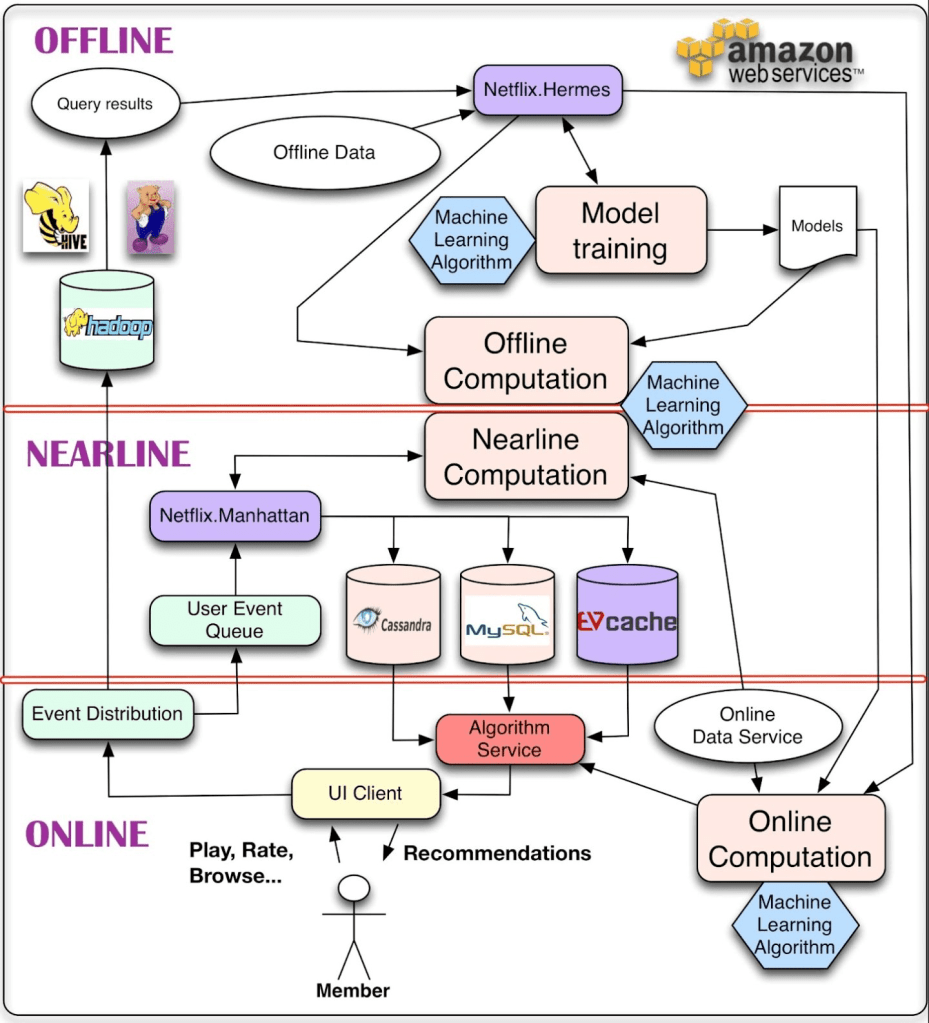
Figure 5 is the recommender system of Netflix. Here is the challenge, can you combine the technical framework of the recommender system discussed in this blog to tell which parts are the data part and which are the model part in the diagram?
Figure 5. Diagram of Netflix recommender system architecture
Reference:
[1] 极客时间《深度学习推荐系统实战》, 王喆 Roku 推荐系统架构负责人,前 hulu 高级研究员,《深度学习推荐系统》作者.
[2] He, Xiangnan, Lizi Liao, Hanwang Zhang, Liqiang Nie, Xia Hu, and Tat-Seng Chua. “Neural collaborative filtering.” In Proceedings of the 26th international conference on world wide web, pp. 173-182. 2017.
[3] Zhou, Guorui, Na Mou, Ying Fan, Qi Pi, Weijie Bian, Chang Zhou, Xiaoqiang Zhu, and Kun Gai. “Deep interest evolution network for click-through rate prediction.” In Proceedings of the AAAI conference on artificial intelligence, vol. 33, no. 01, pp. 5941-5948. 2019.
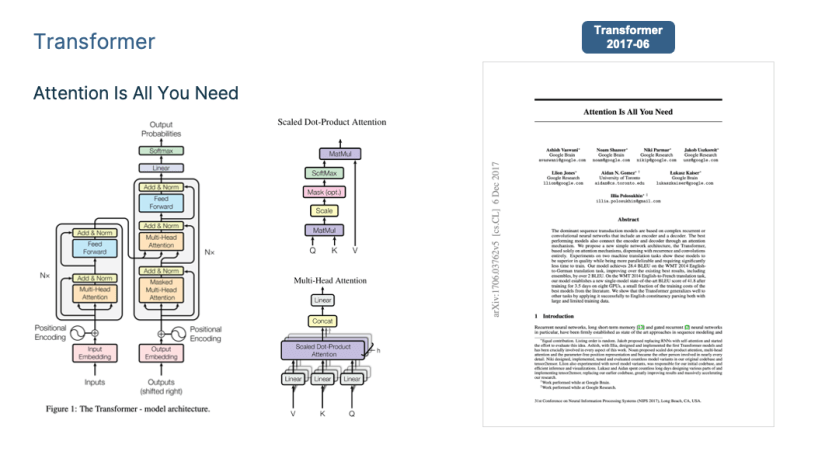
The Transformer from “Attention is All You Need” has been on a lot of people’s minds since 2017.
In this repo, I present an “annotated” version of the Transformer Paper in the form of a line-by-line implementation to build an English-to-Chinese translator with PyTorth deep learning framework.
You know in Australia there is a ‘Covidsafe app‘ for everyone.
The COVIDSafe app speeds up contacting people exposed to coronavirus (COVID-19). This helps us support and protect you, your friends and family. Please read the content on this page before downloading. At the end of the Australian COVID-19 pandemic, users will be prompted to delete the COVIDSafe app from their phone. This will delete all app information on a person’s phone. The information contained in the information storage system will also be destroyed at the end of the pandemic.
So, all those descriptions are trying to tell your information is safe and your privacy is protected with this app. By the way, the COVIDSafe app is the only contact tracing app approved by the Australian Government. I think this means it is the first official one.
This post is for viewers who want to understand a little bit deeper technical details about the technology used in this app. I will quote the document from Apple and keep it as simple as possible. I am not an IOS developer. I am just as curious as you, trying to understand how it measures the risk. And I am not sure if the COVIDSafe app used apple’s framework, LOL~
My only sources are from the webpages of the Australian Government Department of Health and Apple [iOS Framework Document] Exposure Notification April 2020. You can click these Keywords to learn more background knowledge around this app: COVIDSafe, Mesh Network; GDPR; DP3T; Beacon.
So, according to Apple’s document, the following diagram illustrates the general format of Exposure Risk Level Calculation:
Exposure Risk Level Parameters
Transmission Risk — An app-defined flexible value to tag a specific positive key. This value could be tagged based on symptoms, level of diagnosis verification, or other determination from the app or health authority.
Duration (measured by API) — Cumulative duration of the exposure. Days (measured by API) – Days since the exposure incident.
Attenuation (measured by API) – Minimum Bluetooth signal strength attenuation (Transmission Power subtract RSSI).
Level Value: The value, ranging from 1 to 8, that the app assigns to each Level in each of the Exposure Risk Level Parameters.
Level: The eight levels contained within each Exposure Risk Level Parameter.
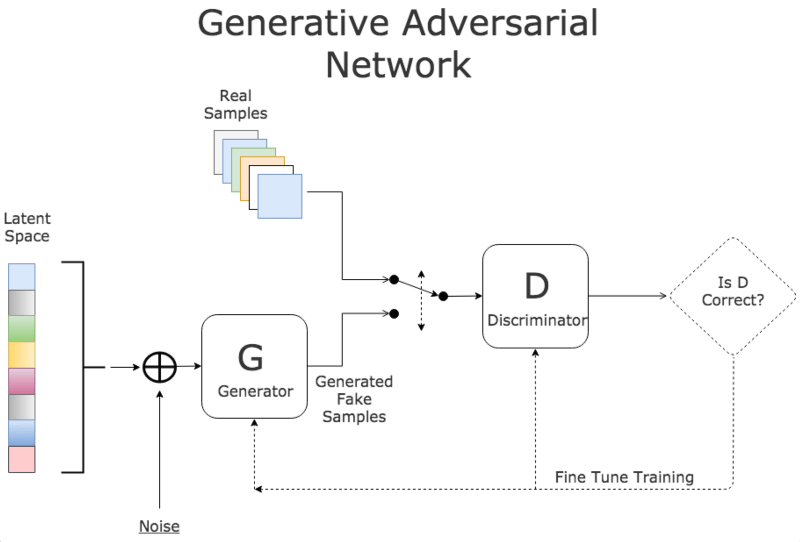
Generative models, like Generative Adversarial Networks (GAN), are a rapidly advancing area of research for computer science and machine intelligence nowadays. It’s hard to keep track of them all, not to mention the incredibly creative ways in which researchers have achieved and been working on.
The following figures demonstrate some results of the current works ( Images from https://blog.openai.com/generative-models/).
GAN learning to generate images (linear time)
VAE learning to generate images (log time)
I think it is necessary to understand the basic pros and cons of it, and it may be very helpful to your own research. I have not fully reviewed the theory and papers, but after skimmed a few papers, I got the impression that the training process of GAN models is very tricky as well as any neural networks model. Thus, there must be a huge improving space for people to make.
Thanks to the internet! There are papers and codes everywhere and nobody will be left behind in these days unless he/she wants to. So working hard and to be a better man (or women or anything good for humanity), cheers!
Here are some papers and blogs that summarized the literature very well.