
Reading Note: The social dilemma of autonomous vehicles

Understand this dilemma will help you to see that it is very hard to align moral algorithms with human values.

The original paper could be found at Science: The social dilemma of autonomous vehicles.

Abstruct: Autonomous vehicles (AVs) should reduce traffic accidents, but they will sometimes have to choose between two evils, such as running over pedestrians or sacrificing themselves and their passenger to save the pedestrians. Defining the algorithms that will help AVs make these moral decisions is a formidable challenge …

It has been well-known that autonomous vehicles (AVs) will change the world in the future.  The AVs have the potential to benefit the world by increasing traffic efficiency, reducing pollution and eliminating up to 90% traffic accidents.

The problem is that not all the crashes could be avoided, some crashes will require the AVs to make difficult ethical decisions in cases that involve unavoidable harm.

In the following figure, we see three scenarios just like what we worried.

The AV may avoid harming several pedestrians by swerving and sacrificing a passerby (Fig1A), or the AV may be faced with the choice of sacrificing its own passenger to save one or more pedestrians (Fig1BC).
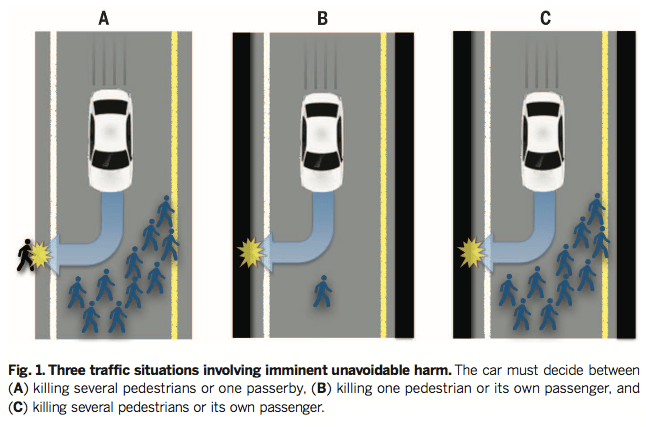
AutoCar figures

Even these scenarios may never arise,  the AV programming must still include decision rules about what to do in such a hypothetical situation.

Thus, the algorithm that controls the AV needs to embed moral principles guiding their decisions in situations of unavoidable harm.

Manufacturers and regulators will need to accomplish three potentially incompatible objectives: being consistent, not causing public outrage, and not discouraging buyers.

Hope this problem will be solved in the future.

Ensemble Methods: Foundations and Algorithms

Ensemble learning is a kind of state-of-the-art machine learning method. It is well known that an ensemble is usually more accurate than a single learner, and ensemble methods have already achieved great success in many real-world tasks.

Here, I recommend a book of Ensemble Learning written by Professor Zhi-Hua Zhou (https://cs.nju.edu.cn/zhouzh/).

Here is the book on Amazon:

@book{zhou2012ensemble,
  title={Ensemble methods: foundations and algorithms},
  author={Zhou, Zhi-Hua},
  year={2012},
  publisher={CRC press}
}

Continue reading “Ensemble Methods: Foundations and Algorithms”

How to design and convert beautiful image into eps file for LaTex (Windows)

A good research paper usually comes with amazing figures to show the readers the methodology, architectures, and results.  It is a common sense that a beautiful and meaningfully figure worth a thousand words and mathematic equations.

Here is my approach.

Tools:

Steps:

Continue reading “How to design and convert beautiful image into eps file for LaTex (Windows)”

An MIT Press book of Deep Learning

The world-famous scholars,  Ian Goodfellow and Yoshua Bengio and Aaron Courville,  has just published an MIT press book of deep learning.

The online version of the book is now complete and will remain available online for free (http://www.deeplearningbook.org/).

authors
I. Goodfellow, Y. Bengio,  and A. Courville

It is believed to be a very good learning material and reference for all the researchers and learners. The pdf of the English version is forbidden due to the copyright issues (Check the FAQ on the page to see more details).  If you do not like reading online, the hardcopy is available on Amazon with a price of 72$ 😦 (I guess reading online is fine).

However, a translated pdf version in Chinese could be found and download on Github. I have to say that this translation speed is impressive. I have been reading this Chinese version and I can tell the quality is good enough for Chinese readers. Many thanks to the team for sharing the Deep Learning knowledge!

Here are the links:

  1. https://github.com/exacity/deeplearningbook-chinese;
  2. https://github.com/exacity/deeplearningbook-chinese/releases/download/v0.4-alpha/dlbook_cn_v0.4-alpha.pdf.

Moreover, the translators state that they will continue updating the book until its final release. Good to be a Chinese right 😛

Citing the book

To cite this book, please use this BibTeX entry:

@book{Goodfellow-et-al-2016,
    title={Deep Learning},
    author={Ian Goodfellow and Yoshua Bengio and Aaron Courville},
    publisher={MIT Press},
    note={\url{http://www.deeplearningbook.org}},
    year={2016}
}
deeplearning
Nice Cover !

Google’s AlphaGo played as Master won more than 50 straight games against the world’s top Go players online

News Source: Google’s AlphaGo AI secretively won more than 50 straight games against the world’s top Go players; and Twitter.

Deepmind founder Demis Hassabis, whose London-based AI startup was acquired by Google in 2014, later confirmed on Twitter that Master is a new version of AlphaGo under “unofficial testing.”

As a very low-rank Go player (Zero Dan :P), this is a stunning news.

Continue reading “Google’s AlphaGo played as Master won more than 50 straight games against the world’s top Go players online”