Recently, Y Combinator hosted Bob McGrew, the former Chief Research Officer at OpenAI and a veteran technologist from PayPal and Palantir. What surprised many was the line of questioning. Instead of asking him how to build the next GPT, founders kept pressing him on a very different topic: Palantir’s FDE model.
Bob admitted that over the past year, nearly every startup he’s advised has been obsessed with learning how this model works in practice.
What Exactly Is FDE?
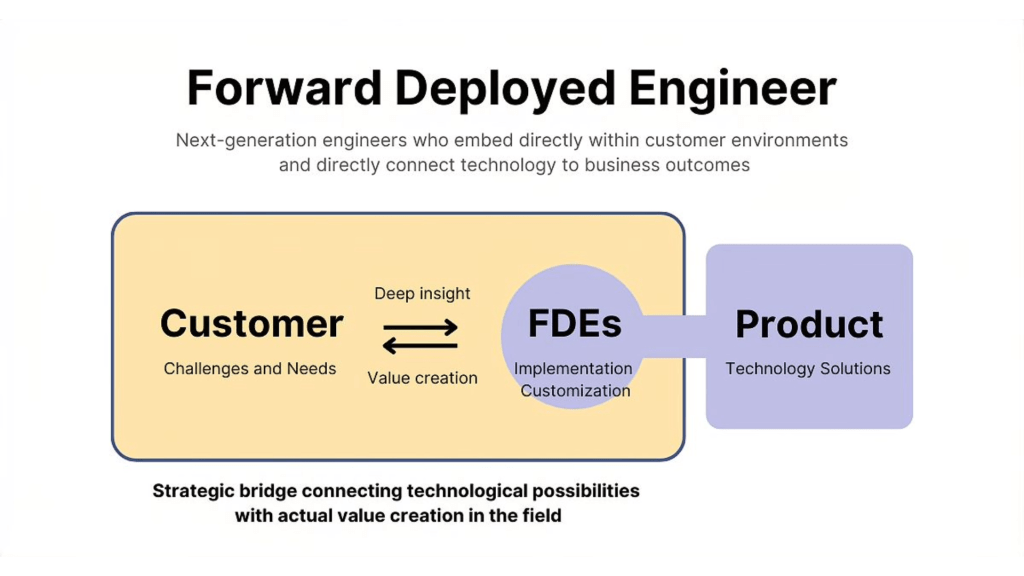
FDE (Forward Deployed Engineer) is a model where engineers embed directly with customers to bridge the gap between what the product aspires to be and what the customer actually needs.
The idea traces back to Palantir’s early days working with U.S. intelligence agencies. The challenges were messy, complex, and had no off-the-shelf solutions. The only way forward was to “build on the ground” with the client. At the time, many dismissed it as unscalable, labor-intensive, and far from the clean SaaS ideal. Fast forward to today, and the very same approach is being embraced by AI startups building agents and enterprise solutions.
How It Works
Palantir structured its FDE teams around two roles:
Echo: the industry-savvy operator who lives inside the customer’s workflow, identifies core pain points, and challenges the status quo.
Delta: the technical builder who can spin up prototypes quickly, solving problems in real time.
Meanwhile, the core product team back at HQ takes these frontline hacks and turns them into platform features. Think of it as paving a permanent road where the FDEs first laid down gravel.
Why It Matters
The strength of the FDE model is that it forges unusually deep relationships with customers. It surfaces real market demand—things no survey or user interview could ever uncover. Done right, it creates a defensible moat.
But it’s also risky. Without discipline, FDE can collapse into traditional consulting or body-shop outsourcing. The litmus test of a healthy model is whether the core platform keeps evolving, making each new deployment faster, cheaper, and more scalable.
Different from Consulting
The distinction is critical:
Consulting delivers one-off solutions.
FDE is about feeding learnings back into the product, so the platform gets stronger with every customer.
This feedback loop—and the ability of product managers to abstract from bespoke requests—is what turns customer-specific fixes into reusable product capabilities.
Why AI Startups Love It
For AI Agent companies, the market is far too fragmented and unpredictable for a “one-size-fits-all” solution. No universal product exists. Embedding deeply with customers isn’t optional—it’s the only way to figure out what works, discover product-market fit, and build enduring platforms.
A Shift in Business Models
Unlike traditional SaaS, which scales on pure subscriptions, FDE contracts are more outcome-driven and flexible. The key lever is product leverage: doing the same amount of frontline work but translating it into larger contracts and less marginal customization over time.
The Bigger Picture
The rise of FDE highlights a paradox of modern tech: at scale, the best companies keep doing the things that “don’t scale.” The gulf between breakthrough AI capabilities and messy, real-world adoption is exactly where the biggest opportunities lie today.
It’s not an easy path—more trench warfare than blitzscaling—but for founders, it may be the only one that works.
This blog examines the rapidly evolving landscape of AI-powered search, comparing Google’s recent transformation with its Search Generative Experience (SGE) and Gemini integration against Perplexity AI‘s native AI-first approach. Both companies now leverage large language models, but with fundamentally different architectures and philosophies.
The New Reality: Google has undergone a dramatic transformation from traditional keyword-based search to an AI-driven conversational answer engine. With the integration of Gemini, LaMDA, PaLM, and the rollout of AI Overviews (formerly SGE), Google now synthesizes information from multiple sources into concise, contextual answers—directly competing with Perplexity’s approach.
Key Findings:
Convergent Evolution: Both platforms now use LLMs for answer generation, but Google maintains its traditional search infrastructure while Perplexity was built AI-first from the ground up
Architecture Philosophy: Google integrates AI capabilities into its existing search ecosystem (hybrid approach), while Perplexity centers everything around RAG and multi-model orchestration (AI-native approach)
AI Technology Stack: Google leverages Gemini (multimodal), LaMDA (conversational), and PaLM models, while Perplexity orchestrates external models (GPT, Claude, Gemini, Llama, DeepSeek)
User Experience: Google provides AI Overviews alongside traditional search results, while Perplexity delivers answer-first experiences with citations
Market Dynamics: The competition has intensified with Google’s AI transformation, making the choice between platforms more about implementation philosophy than fundamental capabilities
This represents a paradigm shift where the question is no longer “traditional vs. AI search” but rather “how to best implement AI-powered search” with different approaches to integration, user experience, and business models.
Keywords: AI Search, RAG, Large Language Models, Search Architecture, Perplexity AI, Google Search, Conversational AI, SGE, Gemini.
Google’s AI Transformation: From PageRank to Gemini-Powered Search
Google has undergone one of the most significant transformations in its history, evolving from a traditional link-based search engine to an AI-powered answer engine. This transformation represents a strategic response to the rise of AI-first search platforms and changing user expectations.
The Search Generative Experience (SGE) Revolution
Google’s Search Generative Experience (SGE), now known as AI Overviews, fundamentally changes how search results are presented:
AI-Synthesized Answers: Instead of just providing links, Google’s AI generates comprehensive insights, explanations, and summaries from multiple sources
Contextual Understanding: Responses consider user context including location, search history, and preferences for personalized results
Multi-Step Query Handling: The system can handle complex, conversational queries that require reasoning and synthesis
Real-Time Information Grounding: AI overviews are grounded in current, real-time information while maintaining accuracy
Google’s LLM Arsenal
Google has strategically integrated multiple advanced AI models into its search infrastructure:
Gemini: The Multimodal Powerhouse
Capabilities: Understands and generates text, images, videos, and audio
Search Integration: Enables complex query handling including visual search, reasoning tasks, and detailed information synthesis
Multimodal Processing: Handles queries that combine text, images, and other media types
LaMDA: Conversational AI Foundation
Purpose: Powers natural, dialogue-like interactions in search
Features: Enables follow-up questions and conversational context maintenance
Role: Provides advanced language processing capabilities
Applications: Powers complex reasoning, translation (100+ languages), and contextual understanding
Scale: Handles extended documents and multimodal inputs
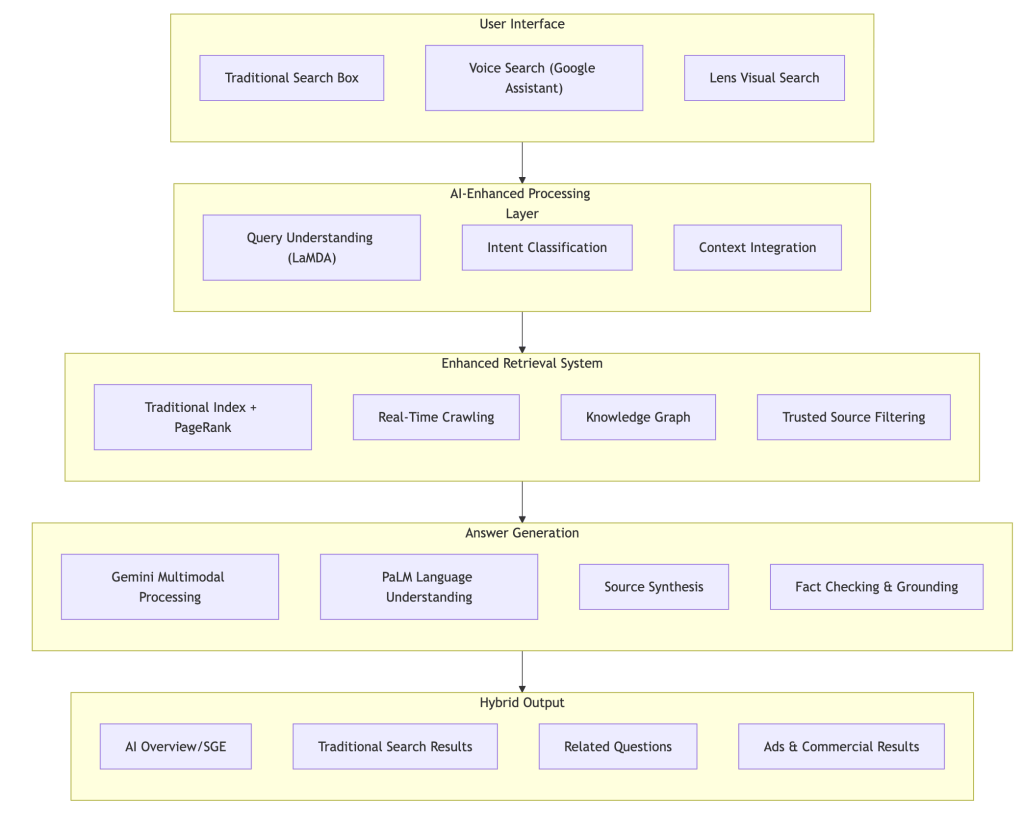
Technical Architecture Integration
Google’s approach differs from AI-first platforms by layering AI capabilities onto existing infrastructure:
Key Differentiators of Google’s AI Search
Hybrid Architecture: Maintains traditional search capabilities while adding AI-powered features
Scale Integration: Leverages existing massive infrastructure and data
DeepMind Synergy: Strategic integration of DeepMind research into commercial search applications
Continuous Learning: ML ranking algorithms and AI models learn from user interactions in real-time
Global Reach: AI features deployed across 100+ languages with localized understanding
Perplexity AI Architecture: The RAG-Powered Search Revolution
Perplexity AI represents a fundamental reimagining of search technology, built on three core innovations:
Retrieval-Augmented Generation (RAG): Combines real-time web crawling with large language model capabilities
Multi-Model Orchestration: Leverages multiple AI models (GPT, Claude, Gemini, Llama, DeepSeek) for optimal responses
Integrated Citation System: Provides transparent source attribution with every answer
The platform offers multiple access points to serve different user needs: Web Interface, Mobile App, Comet Browser, and Enterprise API.
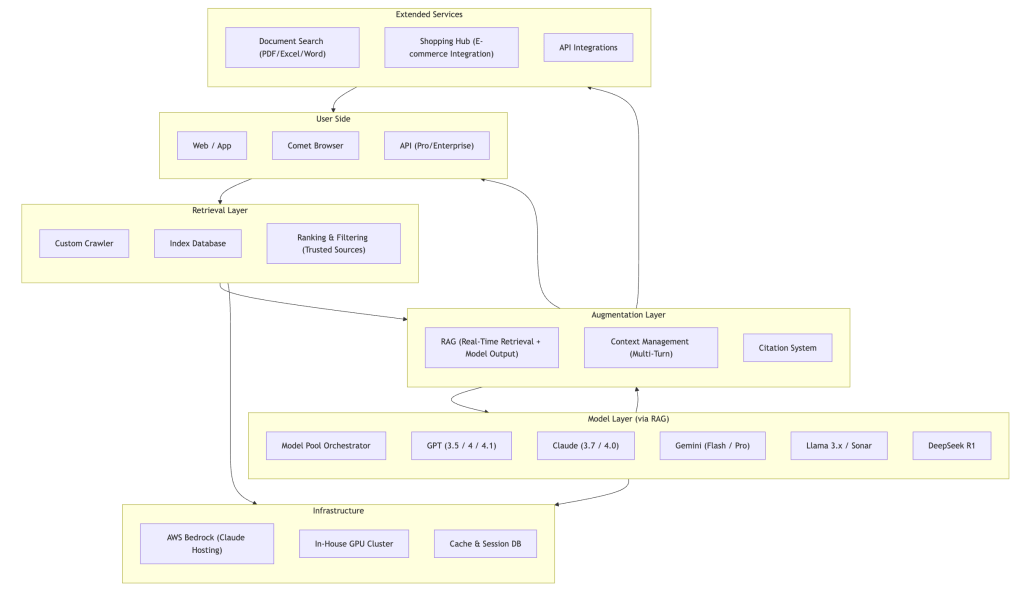
Core Architecture Components
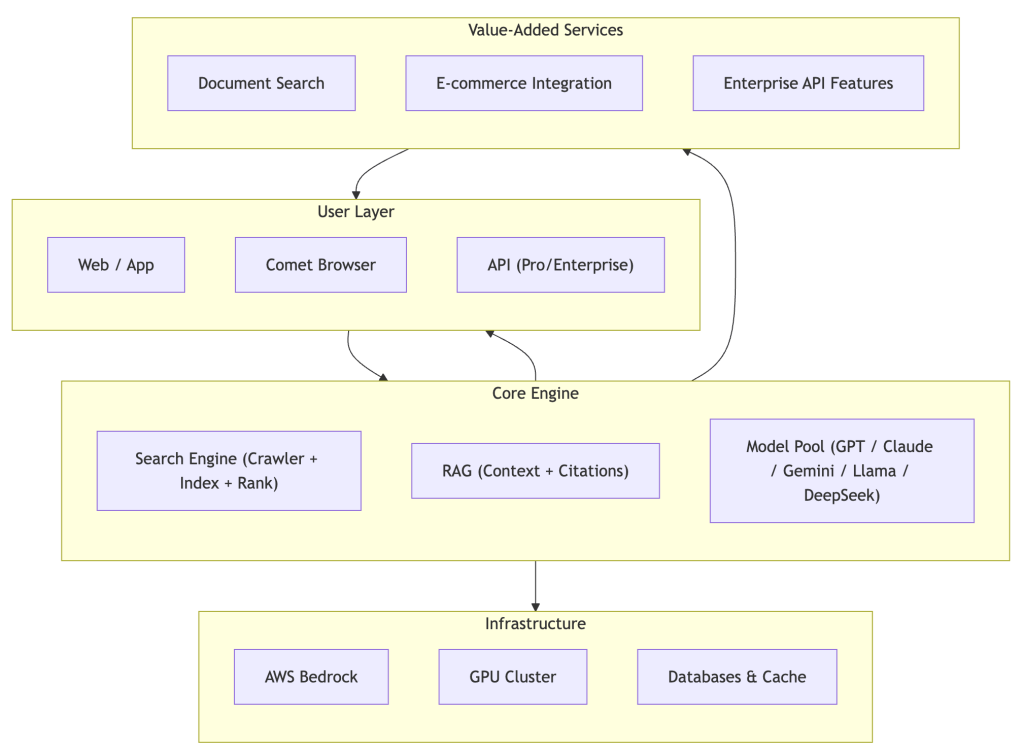
Simplified Architecture View
For executive presentations and high-level discussions, this three-layer view highlights the essential components:
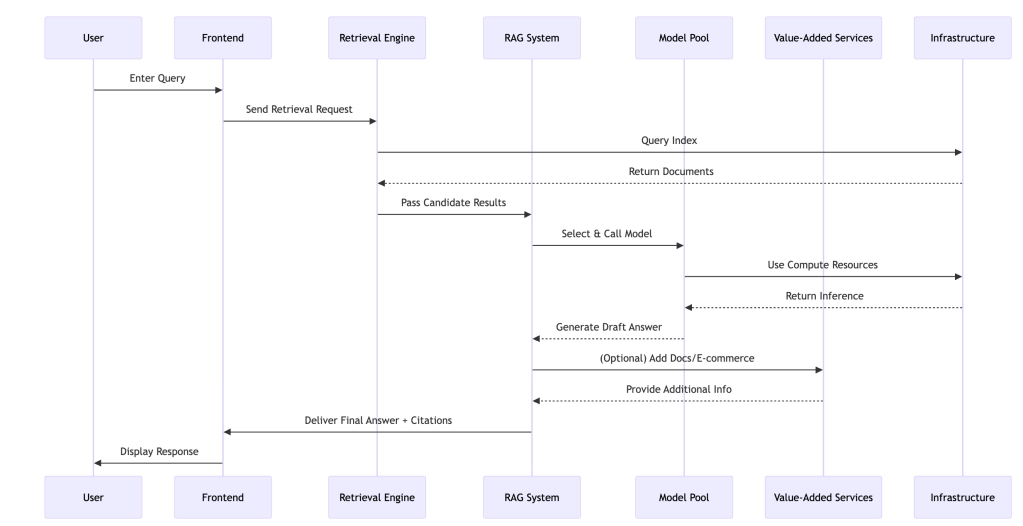
How Perplexity Works: From Query to Answer
Understanding Perplexity’s workflow reveals why it delivers fundamentally different results than traditional search engines. Unlike Google’s approach of matching keywords to indexed pages, Perplexity follows a sophisticated multi-step process:
The Eight-Step Journey
Query Reception: User submits a natural language question through any interface
Real-Time Retrieval: Custom crawlers search the web for current, relevant information
Source Indexing: Retrieved content is processed and indexed in real-time
Context Assembly: RAG system compiles relevant information into coherent context
Model Selection: AI orchestrator chooses the optimal model(s) for the specific query type
Answer Generation: Selected model(s) generate comprehensive responses using retrieved context
Citation Integration: System automatically adds proper source attribution
Response Delivery: Final answer with citations is presented to the user
Technical Workflow Diagram
The sequence below shows how a user query flows through Perplexity’s system.
This process typically completes in under 3 seconds, delivering both speed and accuracy.
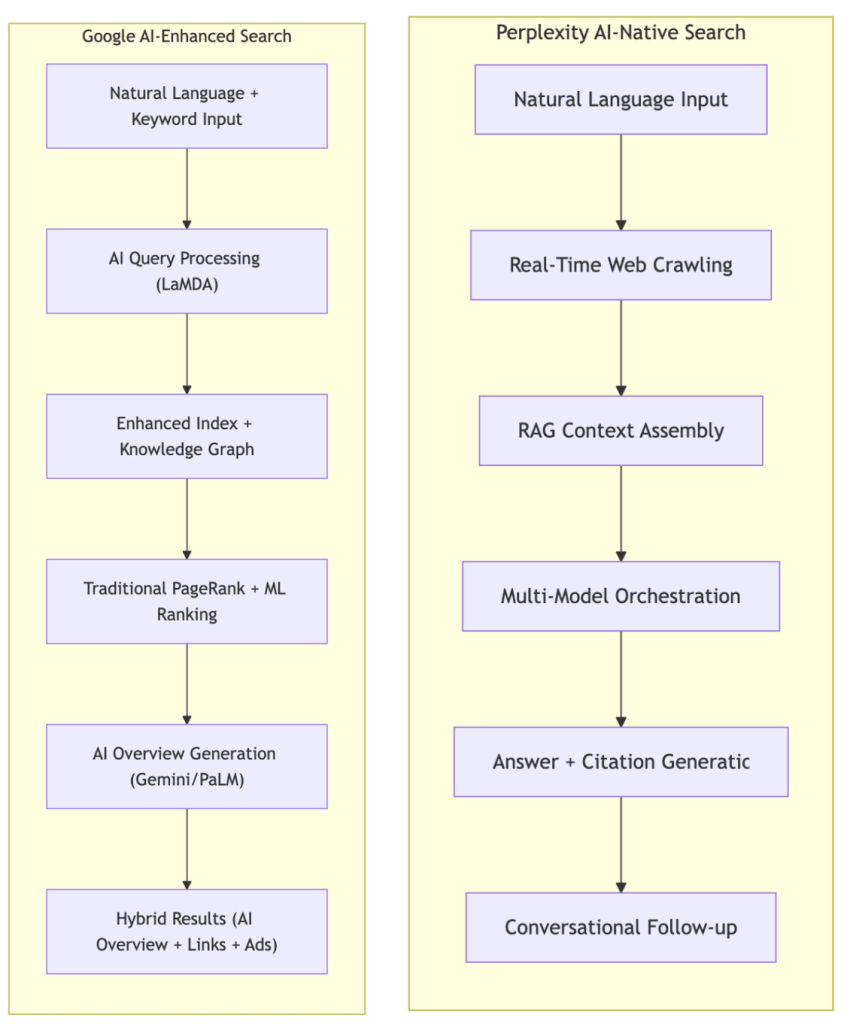
The New Search Paradigm: AI-First vs AI-Enhanced Approaches
The competition between Google and Perplexity has evolved beyond traditional vs. AI search to represent two distinct philosophies for implementing AI-powered search experiences.
The Future of AI-Powered Search: A New Competitive Landscape
The integration of AI into search has fundamentally changed the competitive landscape. Rather than a battle between traditional and AI search, we now see different approaches to implementing AI-powered experiences competing for user mindshare and market position.
Implementation Strategy Battle: Integration vs. Innovation
Google’s Integration Strategy:
Advantage: Massive user base and infrastructure to deploy AI features at scale
Challenge: Balancing AI innovation with existing business model dependencies
Approach: Gradual rollout of AI features while maintaining traditional search options
Perplexity’s Innovation Strategy:
Advantage: Clean slate design optimized for AI-first experiences
Challenge: Building user base and competing with established platforms
Approach: Focus on superior AI experience to drive user acquisition
The Multi-Modal Future
Both platforms are moving toward comprehensive multi-modal experiences:
Visual Search Integration: Google Lens vs. Perplexity’s image understanding capabilities
Voice-First Interactions: Google Assistant integration vs. conversational AI interfaces
Video and Audio Processing: Gemini’s multimodal capabilities vs. orchestrated model approaches
Document Intelligence: Enterprise document search and analysis capabilities
Business Model Evolution Under AI
Advertising Model Transformation:
Google must adapt its ad-centric model to AI Overviews without disrupting user experience
Challenge of monetizing direct answers vs. traditional click-through advertising
Need for new ad formats that work with conversational AI
Subscription and API Models:
Perplexity’s success with subscription tiers validates alternative monetization
Growing enterprise demand for AI-powered search APIs and integrations
Despite different starting points, both platforms are converging on similar technical capabilities:
Real-Time Information: Both now emphasize current, up-to-date information retrieval
Source Attribution: Transparency and citation becoming standard expectations
Conversational Context: Multi-turn conversation support across platforms
Model Diversity: Google developing multiple specialized models, Perplexity orchestrating external models
The Browser and Distribution Channel Wars
Perplexity’s Chrome Acquisition Strategy:
$34.5B all-cash bid for Chrome represents unprecedented ambition in AI search competition
Strategic Value: Control over browser defaults, user data, and search distribution
Market Impact: Success would fundamentally alter competitive dynamics and user acquisition costs
Regulatory Reality: Bid likely serves as strategic positioning and leverage rather than realistic acquisition
Alternative Distribution Strategies:
AI-native browsers (Comet) as specialized entry points
API integrations into enterprise and developer workflows
Mobile-first experiences capturing younger user demographics
Strategic Implications and Future Outlook
The competition between Google’s AI-enhanced approach and Perplexity’s AI-native strategy represents a fascinating case study in how established platforms and startups approach technological transformation differently.
Key Strategic Insights
The AI Integration Challenge: Google’s transformation demonstrates that even dominant platforms must fundamentally reimagine their core products to stay competitive in the AI era
Architecture Philosophy Matters: The choice between hybrid integration (Google) vs. AI-first design (Perplexity) creates different strengths, limitations, and user experiences
Business Model Pressure: AI-powered search challenges traditional advertising models, forcing experimentation with subscriptions, APIs, and premium features
User Behavior Evolution: Both platforms are driving the shift from “search and browse” to “ask and receive” interactions, fundamentally changing how users access information
The New Competitive Dynamics
Advantages of Google’s AI-Enhanced Approach:
Massive scale and infrastructure for global AI deployment
Existing user base to gradually transition to AI features
Deep integration with knowledge graphs and proprietary data
Ability to maintain traditional search alongside AI innovations
Advantages of Perplexity’s AI-Native Approach:
Optimized user experience designed specifically for conversational AI
Agility to implement cutting-edge AI techniques without legacy constraints
Model-agnostic architecture leveraging best-in-class external AI models
Clear value proposition for users seeking direct, cited answers
Looking Ahead: Industry Predictions
Near-Term (1-2 years):
Continued convergence of features between platforms
Google’s global rollout of AI Overviews across all markets and languages
Perplexity’s expansion into enterprise and specialized vertical markets
Emergence of more AI-native search platforms following Perplexity’s model
Medium-Term (3-5 years):
AI-powered search becomes the standard expectation across all platforms
Specialized AI search tools for professional domains (legal, medical, scientific research)
Integration of real-time multimodal capabilities (live video analysis, augmented reality search)
New regulatory frameworks for AI-powered information systems
Long-Term (5+ years):
Fully conversational AI assistants replace traditional search interfaces
Personal AI agents that understand individual context and preferences
Integration with IoT and ambient computing for seamless information access
Potential emergence of decentralized, blockchain-based search alternatives
Recommendations for Stakeholders
For Technology Leaders:
Hybrid Strategy: Consider Google’s approach of enhancing existing systems with AI rather than complete rebuilds
Model Orchestration: Investigate Perplexity’s approach of orchestrating multiple AI models for optimal results
Real-Time Capabilities: Invest in real-time information retrieval and processing systems
Citation Systems: Implement transparent source attribution to build user trust
For Business Strategists:
Revenue Model Innovation: Experiment with subscription, API, and premium feature models beyond traditional advertising
User Experience Focus: Prioritize conversational, answer-first experiences in product development
Distribution Strategy: Evaluate the importance of browser control and default search positions
Competitive Positioning: Decide between AI-enhancement of existing products vs. AI-native alternatives
For Investors:
Platform Risk Assessment: Evaluate how established platforms are adapting to AI disruption
Technology Differentiation: Assess the sustainability of competitive advantages in rapidly evolving AI landscape
Business Model Viability: Monitor the success of alternative monetization strategies beyond advertising
Regulatory Impact: Consider potential regulatory responses to AI-powered information systems and search market concentration
The future of search will be determined by execution quality, user adoption, and the ability to balance innovation with practical business considerations. Both Google and Perplexity have established viable but different paths forward, setting the stage for continued innovation and competition in the AI-powered search landscape.
Monitor the browser control battle and distribution channel acquisitions
Technology Differentiation: Assess the sustainability of competitive advantages in rapidly evolving AI landscape
Business Model Viability: Monitor the success of alternative monetization strategies beyond advertising
Regulatory Impact: Consider potential regulatory responses to AI-powered information systems and search market concentration
Conclusion
The evolution of search from Google’s traditional PageRank-driven approach to today’s AI-powered landscape represents one of the most significant technological shifts in internet history. Google’s recent transformation with its Search Generative Experience and Gemini integration demonstrates that even the most successful platforms must reinvent themselves to remain competitive in the AI era.
The competition between Google’s AI-enhanced strategy and Perplexity’s AI-native approach offers valuable insights into different paths for implementing AI at scale. Google’s hybrid approach leverages massive existing infrastructure while gradually transforming user experiences, while Perplexity’s clean-slate design optimizes entirely for conversational AI interactions.
As both platforms continue to evolve, the ultimate winners will be users who gain access to more intelligent, efficient, and helpful ways to access information. The future of search will likely feature elements of both approaches: the scale and comprehensiveness of Google’s enhanced platform combined with the conversational fluency and transparency of AI-native solutions.
The battle for search supremacy in the AI era has only just begun, and the innovations emerging from this competition will shape how humanity accesses and interacts with information for decades to come.
This analysis reflects the state of AI-powered search as of August 2025. The rapidly evolving nature of AI technology and competitive dynamics may significantly impact future developments. Both Google and Perplexity continue to innovate at unprecedented pace, making ongoing monitoring essential for stakeholders in this space.This analysis represents the current state of AI-powered search as of August 2025. The rapidly evolving nature of AI technology and competitive landscape may impact future developments.
AI technology is increasingly being utilized in industry and retail sectors to enhance efficiency, productivity, and customer experiences. In this post, we firstly revisit the relationship between the industry and retail sections, then provide some common AI technologies and applications used in these domains.
Industry and Retail Relationship
The key difference between industry and retail lies in their primary functions and the nature of their operations:
Industry:
Industry, often referred to as manufacturing or production, involves the creation, extraction, or processing of raw materials and the transformation of these materials into finished goods or products.
Industrial businesses are typically involved in activities like manufacturing, mining, construction, or agriculture.
The primary focus of the industry is to produce goods on a large scale, which are then sold to other businesses, wholesalers, or retailers. These goods are often used as inputs for other industries or for further processing.
Industries may have complex production processes, rely on machinery and technology, and require substantial capital investment.
Retail:
Retail, on the other hand, involves the sale of finished products or goods directly to the end consumers for personal use. Retailers act as intermediaries between manufacturers or wholesalers and the end customers.
Retailers can take various forms, including physical stores, e-commerce websites, supermarkets, boutiques, and more.
Retailers may carry a wide range of products, including those manufactured by various industries. They focus on providing a convenient and accessible point of purchase for consumers.
Retail operations are primarily concerned with merchandising, marketing, customer service, inventory management, and creating a satisfying shopping experience for consumers.
AI in Industry
AI, or artificial intelligence, is revolutionizing industry sectors by powering various applications and technologies that enhance efficiency, productivity, and customer experiences. Here are some common AI technologies and applications used in these domains:
1. Robotics and Automation: AI-driven robots and automation systems are used in manufacturing to perform repetitive, high-precision tasks, such as assembly, welding, and quality control. Machine learning algorithms enable these robots to adapt and improve their performance over time.
2. Predictive Maintenance: AI is used to predict when industrial equipment, such as machinery or vehicles, is likely to fail. This allows companies to schedule maintenance proactively, reducing downtime and maintenance costs.
3. Quality Control: Computer vision and machine learning algorithms are employed for quality control processes. They can quickly identify defects or irregularities in products, reducing the number of faulty items reaching the market.
4. Supply Chain Optimization: AI helps in optimizing the supply chain by predicting demand, managing inventory, and optimizing routes for logistics and transportation.
5. Process Optimization: AI can optimize manufacturing processes by adjusting parameters in real time to increase efficiency and reduce energy consumption.
6. Safety and Compliance: AI-driven systems can monitor and enhance workplace safety, ensuring that industrial facilities comply with regulations and safety standards.
AI in Retail
AI technology is revolutionizing the retail sector too, introducing innovative solutions and transforming the way businesses engage with customers. Here are some key AI technologies and applications used in retail:
1. Personalized Marketing: AI is used to analyze customer data and behaviours to provide personalized product recommendations, targeted marketing campaigns, and customized shopping experiences.
2. Chatbots and Virtual Assistants: Retailers employ AI-powered chatbots and virtual assistants to provide customer support, answer queries, and assist with online shopping.
3. Inventory Management: AI can optimize inventory levels and replenishment by analyzing sales data and demand patterns, reducing stockouts and overstock situations.
4. Price Optimization: Retailers use AI to dynamically adjust prices based on various factors, such as demand, competition, and customer behaviour, to maximize revenue and profits.
5. Visual Search and Image Recognition: AI enables visual search in e-commerce, allowing customers to find products by uploading images or using images they find online.
6. Supply Chain and Logistics: AI helps optimize supply chain operations, route planning, and warehouse management, improving efficiency and reducing costs.
7. In-Store Analytics: AI-powered systems can analyze in-store customer behaviour, enabling retailers to improve store layouts, planogram designs, and customer engagement strategies.
8. Fraud Detection: AI is used to detect and prevent fraudulent activities, such as credit card fraud and return fraud, to protect both retailers and customers.
Summary
AI’s potential to transform industry and retail is huge and its future applications are very promising. As AI technologies advance, we can expect increased levels of automation, personalization, and optimization in industry and retail operations.
AI technologies in these sectors often rely on machine learning (ML), deep learning (DL), natural language processing (NLP), and computer vision (CV), and now Generative Large Language Models (LLM) to analyze and gain insights from data. These AI applications are continuously evolving and are changing the way businesses in these sectors operate, leading to improved processes and customer experiences.
AI will drive high levels of efficiency, innovation, and customer satisfaction in these sectors, ultimately revolutionizing the way businesses operate and interact with consumers.




 C. Cui's Blog