
AI-Powered Search: Google’s Transformation vs. Perplexity

TL;DR, Play the podcast (Audio Overview generated by NotebookLM)

  1. Abstract
  2. Google’s AI Transformation: From PageRank to Gemini-Powered Search
    1. The Search Generative Experience (SGE) Revolution
    2. Google’s LLM Arsenal
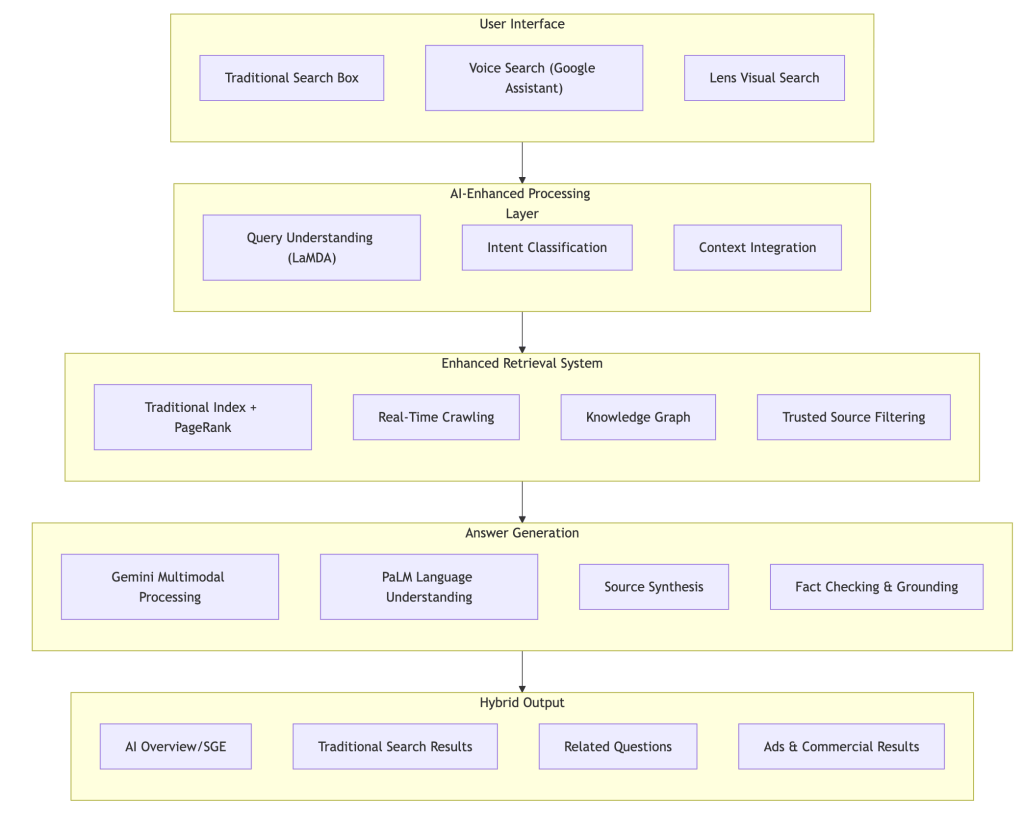
    3. Technical Architecture Integration
    4. Key Differentiators of Google’s AI Search
  3. Perplexity AI Architecture: The RAG-Powered Search Revolution
    1. Simplified Architecture View
    2. How Perplexity Works: From Query to Answer
    3. Technical Workflow Diagram
  4. The New Search Paradigm: AI-First vs AI-Enhanced Approaches
    1. Google’s Philosophy: “AI-Enhanced Universal Search”
    2. Perplexity’s Philosophy: “AI-Native Conversational Search”
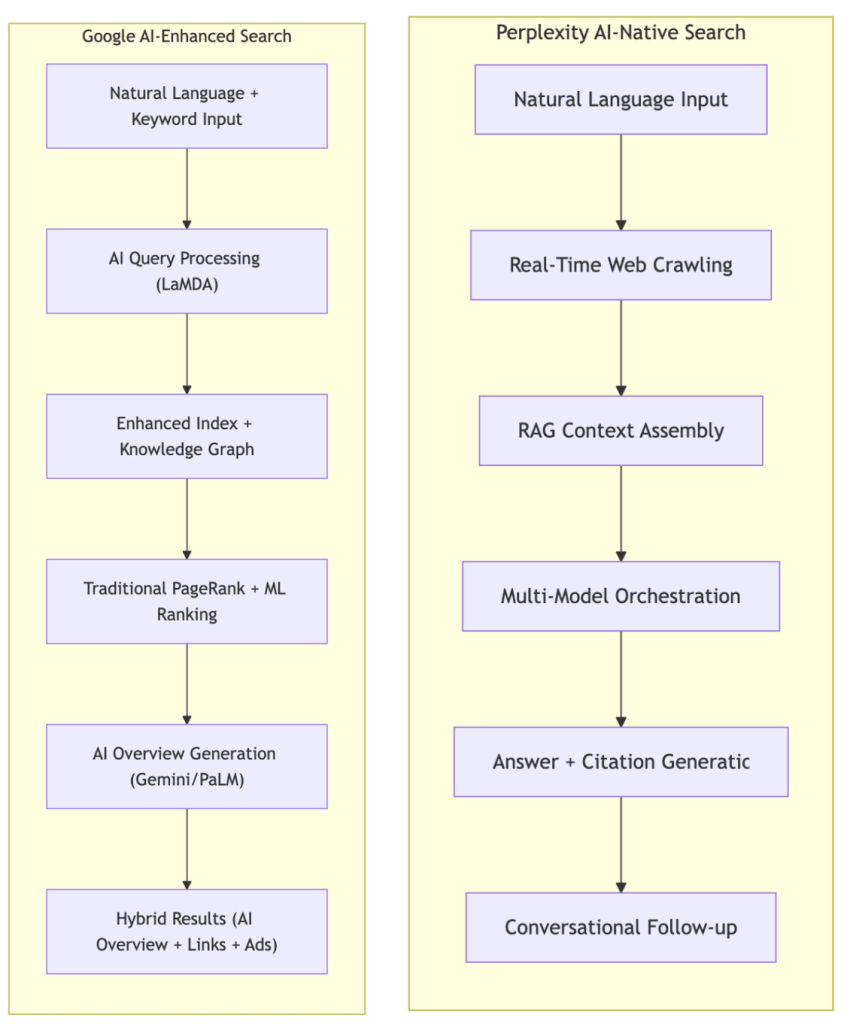
    3. Comprehensive Technology & Business Comparison
  5. The Future of AI-Powered Search: A New Competitive Landscape
    1. Implementation Strategy Battle: Integration vs. Innovation
    2. The Multi-Modal Future
    3. Business Model Evolution Under AI
    4. Technical Architecture Convergence
    5. The Browser and Distribution Channel Wars
  6. Strategic Implications and Future Outlook
    1. Key Strategic Insights
    2. The New Competitive Dynamics
    3. Looking Ahead: Industry Predictions
  7. Recommendations for Stakeholders
  8. Conclusion

Abstract

This blog examines the rapidly evolving landscape of AI-powered search, comparing Google’s recent transformation with its Search Generative Experience (SGE) and Gemini integration against Perplexity AI‘s native AI-first approach. Both companies now leverage large language models, but with fundamentally different architectures and philosophies.

The New Reality: Google has undergone a dramatic transformation from traditional keyword-based search to an AI-driven conversational answer engine. With the integration of Gemini, LaMDA, PaLM, and the rollout of AI Overviews (formerly SGE), Google now synthesizes information from multiple sources into concise, contextual answers—directly competing with Perplexity’s approach.

Key Findings:

  • Convergent Evolution: Both platforms now use LLMs for answer generation, but Google maintains its traditional search infrastructure while Perplexity was built AI-first from the ground up
  • Architecture Philosophy: Google integrates AI capabilities into its existing search ecosystem (hybrid approach), while Perplexity centers everything around RAG and multi-model orchestration (AI-native approach)
  • AI Technology Stack: Google leverages Gemini (multimodal), LaMDA (conversational), and PaLM models, while Perplexity orchestrates external models (GPT, Claude, Gemini, Llama, DeepSeek)
  • User Experience: Google provides AI Overviews alongside traditional search results, while Perplexity delivers answer-first experiences with citations
  • Market Dynamics: The competition has intensified with Google’s AI transformation, making the choice between platforms more about implementation philosophy than fundamental capabilities

This represents a paradigm shift where the question is no longer “traditional vs. AI search” but rather “how to best implement AI-powered search” with different approaches to integration, user experience, and business models.

Keywords: AI Search, RAG, Large Language Models, Search Architecture, Perplexity AI, Google Search, Conversational AI, SGE, Gemini.

Google has undergone one of the most significant transformations in its history, evolving from a traditional link-based search engine to an AI-powered answer engine. This transformation represents a strategic response to the rise of AI-first search platforms and changing user expectations.

The Search Generative Experience (SGE) Revolution

Google’s Search Generative Experience (SGE), now known as AI Overviews, fundamentally changes how search results are presented:

  • AI-Synthesized Answers: Instead of just providing links, Google’s AI generates comprehensive insights, explanations, and summaries from multiple sources
  • Contextual Understanding: Responses consider user context including location, search history, and preferences for personalized results
  • Multi-Step Query Handling: The system can handle complex, conversational queries that require reasoning and synthesis
  • Real-Time Information Grounding: AI overviews are grounded in current, real-time information while maintaining accuracy

Google’s LLM Arsenal

Google has strategically integrated multiple advanced AI models into its search infrastructure:

Gemini: The Multimodal Powerhouse
  • Capabilities: Understands and generates text, images, videos, and audio
  • Search Integration: Enables complex query handling including visual search, reasoning tasks, and detailed information synthesis
  • Multimodal Processing: Handles queries that combine text, images, and other media types
LaMDA: Conversational AI Foundation
  • Purpose: Powers natural, dialogue-like interactions in search
  • Features: Enables follow-up questions and conversational context maintenance
  • Integration: Supports Google’s shift toward conversational search experiences

PaLM: Large-Scale Language Understanding

  • Role: Provides advanced language processing capabilities
  • Applications: Powers complex reasoning, translation (100+ languages), and contextual understanding
  • Scale: Handles extended documents and multimodal inputs

Technical Architecture Integration

Google’s approach differs from AI-first platforms by layering AI capabilities onto existing infrastructure:

  • Hybrid Architecture: Maintains traditional search capabilities while adding AI-powered features
  • Scale Integration: Leverages existing massive infrastructure and data
  • DeepMind Synergy: Strategic integration of DeepMind research into commercial search applications
  • Continuous Learning: ML ranking algorithms and AI models learn from user interactions in real-time
  • Global Reach: AI features deployed across 100+ languages with localized understanding

Perplexity AI Architecture: The RAG-Powered Search Revolution

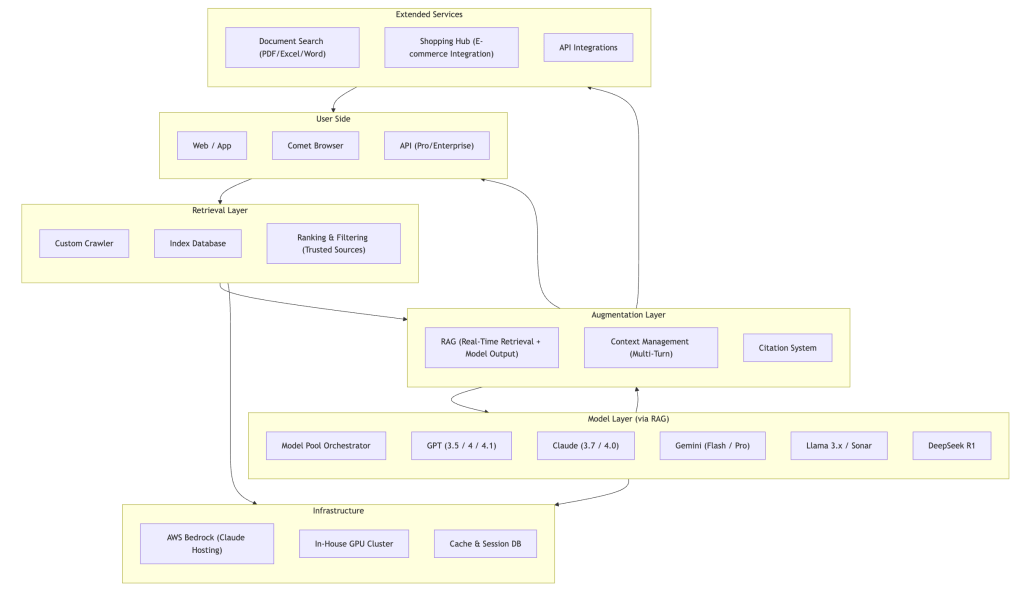
Perplexity AI represents a fundamental reimagining of search technology, built on three core innovations:

  1. Retrieval-Augmented Generation (RAG): Combines real-time web crawling with large language model capabilities
  2. Multi-Model Orchestration: Leverages multiple AI models (GPT, Claude, Gemini, Llama, DeepSeek) for optimal responses
  3. Integrated Citation System: Provides transparent source attribution with every answer

The platform offers multiple access points to serve different user needs: Web Interface, Mobile App, Comet Browser, and Enterprise API.

Core Architecture Components

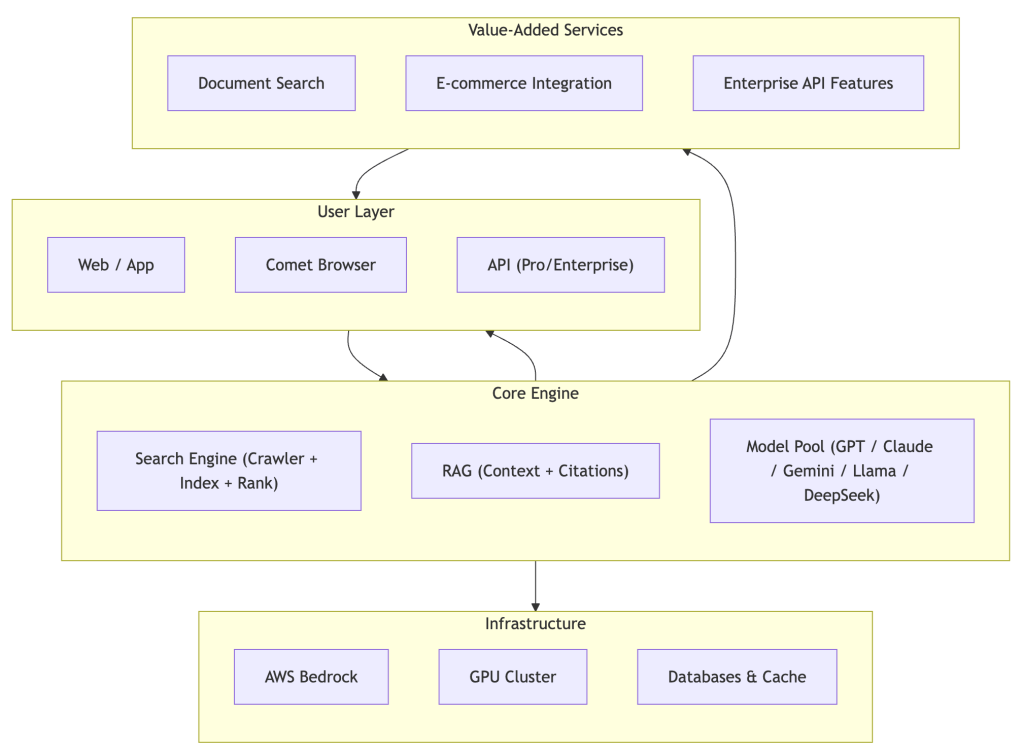
Simplified Architecture View

For executive presentations and high-level discussions, this three-layer view highlights the essential components:

How Perplexity Works: From Query to Answer

Understanding Perplexity’s workflow reveals why it delivers fundamentally different results than traditional search engines. Unlike Google’s approach of matching keywords to indexed pages, Perplexity follows a sophisticated multi-step process:

The Eight-Step Journey

  1. Query Reception: User submits a natural language question through any interface
  2. Real-Time Retrieval: Custom crawlers search the web for current, relevant information
  3. Source Indexing: Retrieved content is processed and indexed in real-time
  4. Context Assembly: RAG system compiles relevant information into coherent context
  5. Model Selection: AI orchestrator chooses the optimal model(s) for the specific query type
  6. Answer Generation: Selected model(s) generate comprehensive responses using retrieved context
  7. Citation Integration: System automatically adds proper source attribution
  8. Response Delivery: Final answer with citations is presented to the user

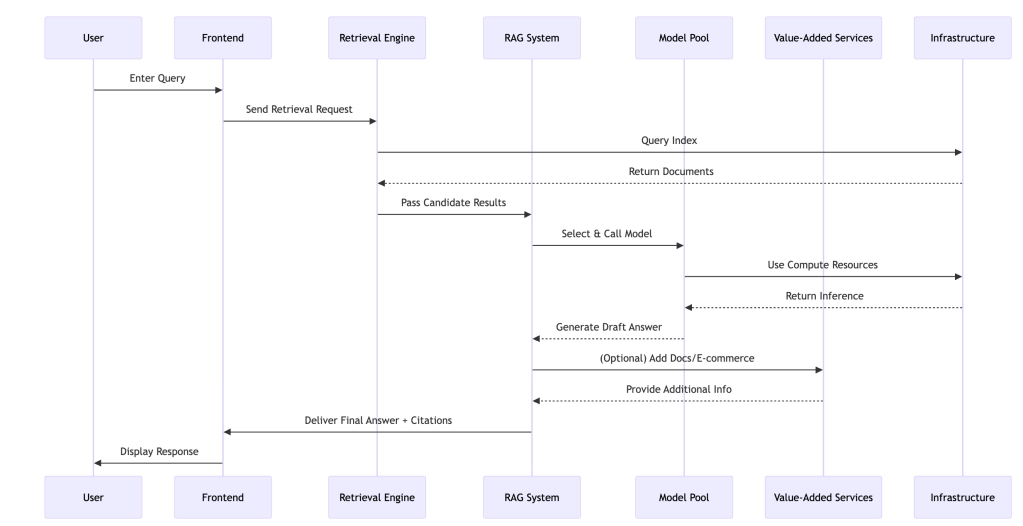
Technical Workflow Diagram

The sequence below shows how a user query flows through Perplexity’s system.

This process typically completes in under 3 seconds, delivering both speed and accuracy.

The New Search Paradigm: AI-First vs AI-Enhanced Approaches

The competition between Google and Perplexity has evolved beyond traditional vs. AI search to represent two distinct philosophies for implementing AI-powered search experiences.

  • Hybrid Integration: Layer advanced AI capabilities onto proven search infrastructure
  • Comprehensive Coverage: Maintain traditional search results alongside AI-generated overviews
  • Gradual Transformation: Evolve existing user behaviors rather than replace them entirely
  • Scale Advantage: Leverage massive existing data and infrastructure for AI training and deployment
  • Model Agnostic: Orchestrate best-in-class models rather than developing proprietary AI
  • Clean Slate Design: Built from the ground up with AI-first architecture
  • Answer-Centric: Focus entirely on direct answer generation with source attribution
  • Conversational Flow: Design for multi-turn, contextual conversations rather than single queries

Comprehensive Technology & Business Comparison

DimensionGoogle AI-Enhanced SearchPerplexity AI-Native Search
InputNatural language + traditional keywordsPure natural language, conversational
AI ModelsGemini, LaMDA, PaLM (proprietary)GPT, Claude, Gemini, Llama, DeepSeek (orchestrated)
ArchitectureHybrid (AI + traditional infrastructure)Pure AI-first (RAG-centered)
RetrievalEnhanced index + Knowledge Graph + real-timeCustom crawler + real-time retrieval
Core TechAI Overviews + traditional rankingRAG + multi-model orchestration
OutputHybrid (AI Overview + links + ads)Direct answers with citations
ContextLimited conversational memoryFull multi-turn conversation memory
ExtensionsMaps, News, Shopping, Ads integrationDocument search, e-commerce, APIs
BusinessAd-driven + AI premium featuresSubscription + API + e-commerce
UX“AI answers + traditional options”“Conversational AI assistant”
ProductsGoogle Search with SGE/AI OverviewPerplexity Web/App, Comet Browser
DeploymentGlobal rollout with localizationGlobal expansion, English-focused
Data AdvantageMassive proprietary data + real-timeReal-time web data + model diversity
ProductsGoogle Search, AdsPerplexity Web/App, Comet Browser

The Future of AI-Powered Search: A New Competitive Landscape

The integration of AI into search has fundamentally changed the competitive landscape. Rather than a battle between traditional and AI search, we now see different approaches to implementing AI-powered experiences competing for user mindshare and market position.

Implementation Strategy Battle: Integration vs. Innovation

Google’s Integration Strategy:

  • Advantage: Massive user base and infrastructure to deploy AI features at scale
  • Challenge: Balancing AI innovation with existing business model dependencies
  • Approach: Gradual rollout of AI features while maintaining traditional search options

Perplexity’s Innovation Strategy:

  • Advantage: Clean slate design optimized for AI-first experiences
  • Challenge: Building user base and competing with established platforms
  • Approach: Focus on superior AI experience to drive user acquisition

The Multi-Modal Future

Both platforms are moving toward comprehensive multi-modal experiences:

  • Visual Search Integration: Google Lens vs. Perplexity’s image understanding capabilities
  • Voice-First Interactions: Google Assistant integration vs. conversational AI interfaces
  • Video and Audio Processing: Gemini’s multimodal capabilities vs. orchestrated model approaches
  • Document Intelligence: Enterprise document search and analysis capabilities

Business Model Evolution Under AI

Advertising Model Transformation:

  • Google must adapt its ad-centric model to AI Overviews without disrupting user experience
  • Challenge of monetizing direct answers vs. traditional click-through advertising
  • Need for new ad formats that work with conversational AI

Subscription and API Models:

  • Perplexity’s success with subscription tiers validates alternative monetization
  • Growing enterprise demand for AI-powered search APIs and integrations
  • Premium features becoming differentiators (document search, advanced models, higher usage limits)

Technical Architecture Convergence

Despite different starting points, both platforms are converging on similar technical capabilities:

  • Real-Time Information: Both now emphasize current, up-to-date information retrieval
  • Source Attribution: Transparency and citation becoming standard expectations
  • Conversational Context: Multi-turn conversation support across platforms
  • Model Diversity: Google developing multiple specialized models, Perplexity orchestrating external models

The Browser and Distribution Channel Wars

Perplexity’s Chrome Acquisition Strategy:

  • $34.5B all-cash bid for Chrome represents unprecedented ambition in AI search competition
  • Strategic Value: Control over browser defaults, user data, and search distribution
  • Market Impact: Success would fundamentally alter competitive dynamics and user acquisition costs
  • Regulatory Reality: Bid likely serves as strategic positioning and leverage rather than realistic acquisition

Alternative Distribution Strategies:

  • AI-native browsers (Comet) as specialized entry points
  • API integrations into enterprise and developer workflows
  • Mobile-first experiences capturing younger user demographics

Strategic Implications and Future Outlook

The competition between Google’s AI-enhanced approach and Perplexity’s AI-native strategy represents a fascinating case study in how established platforms and startups approach technological transformation differently.

Key Strategic Insights

  • The AI Integration Challenge: Google’s transformation demonstrates that even dominant platforms must fundamentally reimagine their core products to stay competitive in the AI era
  • Architecture Philosophy Matters: The choice between hybrid integration (Google) vs. AI-first design (Perplexity) creates different strengths, limitations, and user experiences
  • Business Model Pressure: AI-powered search challenges traditional advertising models, forcing experimentation with subscriptions, APIs, and premium features
  • User Behavior Evolution: Both platforms are driving the shift from “search and browse” to “ask and receive” interactions, fundamentally changing how users access information

The New Competitive Dynamics

Advantages of Google’s AI-Enhanced Approach:

  • Massive scale and infrastructure for global AI deployment
  • Existing user base to gradually transition to AI features
  • Deep integration with knowledge graphs and proprietary data
  • Ability to maintain traditional search alongside AI innovations

Advantages of Perplexity’s AI-Native Approach:

  • Optimized user experience designed specifically for conversational AI
  • Agility to implement cutting-edge AI techniques without legacy constraints
  • Model-agnostic architecture leveraging best-in-class external AI models
  • Clear value proposition for users seeking direct, cited answers

Looking Ahead: Industry Predictions

Near-Term (1-2 years):

  • Continued convergence of features between platforms
  • Google’s global rollout of AI Overviews across all markets and languages
  • Perplexity’s expansion into enterprise and specialized vertical markets
  • Emergence of more AI-native search platforms following Perplexity’s model

Medium-Term (3-5 years):

  • AI-powered search becomes the standard expectation across all platforms
  • Specialized AI search tools for professional domains (legal, medical, scientific research)
  • Integration of real-time multimodal capabilities (live video analysis, augmented reality search)
  • New regulatory frameworks for AI-powered information systems

Long-Term (5+ years):

  • Fully conversational AI assistants replace traditional search interfaces
  • Personal AI agents that understand individual context and preferences
  • Integration with IoT and ambient computing for seamless information access
  • Potential emergence of decentralized, blockchain-based search alternatives

Recommendations for Stakeholders

For Technology Leaders:

  • Hybrid Strategy: Consider Google’s approach of enhancing existing systems with AI rather than complete rebuilds
  • Model Orchestration: Investigate Perplexity’s approach of orchestrating multiple AI models for optimal results
  • Real-Time Capabilities: Invest in real-time information retrieval and processing systems
  • Citation Systems: Implement transparent source attribution to build user trust

For Business Strategists:

  • Revenue Model Innovation: Experiment with subscription, API, and premium feature models beyond traditional advertising
  • User Experience Focus: Prioritize conversational, answer-first experiences in product development
  • Distribution Strategy: Evaluate the importance of browser control and default search positions
  • Competitive Positioning: Decide between AI-enhancement of existing products vs. AI-native alternatives

For Investors:

  • Platform Risk Assessment: Evaluate how established platforms are adapting to AI disruption
  • Technology Differentiation: Assess the sustainability of competitive advantages in rapidly evolving AI landscape
  • Business Model Viability: Monitor the success of alternative monetization strategies beyond advertising
  • Regulatory Impact: Consider potential regulatory responses to AI-powered information systems and search market concentration

The future of search will be determined by execution quality, user adoption, and the ability to balance innovation with practical business considerations. Both Google and Perplexity have established viable but different paths forward, setting the stage for continued innovation and competition in the AI-powered search landscape.

  • Monitor the browser control battle and distribution channel acquisitions
  • Technology Differentiation: Assess the sustainability of competitive advantages in rapidly evolving AI landscape
  • Business Model Viability: Monitor the success of alternative monetization strategies beyond advertising
  • Regulatory Impact: Consider potential regulatory responses to AI-powered information systems and search market concentration

Conclusion

The evolution of search from Google’s traditional PageRank-driven approach to today’s AI-powered landscape represents one of the most significant technological shifts in internet history. Google’s recent transformation with its Search Generative Experience and Gemini integration demonstrates that even the most successful platforms must reinvent themselves to remain competitive in the AI era.

The competition between Google’s AI-enhanced strategy and Perplexity’s AI-native approach offers valuable insights into different paths for implementing AI at scale. Google’s hybrid approach leverages massive existing infrastructure while gradually transforming user experiences, while Perplexity’s clean-slate design optimizes entirely for conversational AI interactions.

As both platforms continue to evolve, the ultimate winners will be users who gain access to more intelligent, efficient, and helpful ways to access information. The future of search will likely feature elements of both approaches: the scale and comprehensiveness of Google’s enhanced platform combined with the conversational fluency and transparency of AI-native solutions.

The battle for search supremacy in the AI era has only just begun, and the innovations emerging from this competition will shape how humanity accesses and interacts with information for decades to come.


This analysis reflects the state of AI-powered search as of August 2025. The rapidly evolving nature of AI technology and competitive dynamics may significantly impact future developments. Both Google and Perplexity continue to innovate at unprecedented pace, making ongoing monitoring essential for stakeholders in this space. This analysis represents the current state of AI-powered search as of August 2025. The rapidly evolving nature of AI technology and competitive landscape may impact future developments.

Prompt Engineering for LLM

2024-Feb-04: 1st Version

  1. Introduction
  2. Basic Prompting
    1. Zero-shot
    2. Few-shot
    3. Hallucination
  3. Perfect Prompt Formula for ChatBots
  4. RAG, CoT, ReACT, SASE, DSP …
    1. RAG: Retrieval-Augmented Generation
    2. CoT: Chain-of-Thought
    3. Self-Ask + Search Engine
    4. ReAct: Reasoning and Acting
    5. DSP: Directional Stimulus Prompting
  5. Summary and Conclusion
  6. Reference
Prompt engineering is like adjusting audio without opening the equipment.

Introduction

Prompt Engineering, also known as In-Context Prompting, refers to methods for communicating with a Large Language Model (LLM) like GPT (Generative Pre-trained Transformer) to manipulate/steer its behaviour for expected outcomes without updating, retraining or fine-tuning the model weights. 

Researchers, developers, or users may engage in prompt engineering to instruct a model for specific tasks, improve the model’s performance, or adapt it to better understand and respond to particular inputs. It is an empirical science and the effect of prompt engineering methods can vary a lot among models, thus requiring heavy experimentation and heuristics.

This post only focuses on prompt engineering for autoregressive language models, so nothing with image generation or multimodality models.

Basic Prompting

Zero-shot and few-shot learning are the two most basic approaches for prompting the model, pioneered by many LLM papers and commonly used for benchmarking LLM performance. That is to say, Zero-shot and few-shot testing are scenarios used to evaluate the performance of large language models (LLMs) in handling tasks with little or no training data. Here are examples for both:

Zero-shot

Zero-shot learning simply feeds the task text to the model and asks for results.

Scenario: Text Completion (Please try the following input in ChatGPT or Google Bard)

Input:

Task: Complete the following sentence:

Input: The capital of France is ____________.

Output (ChatGPT / Bard):

Output: The capital of France is Paris.

Few-shot

Few-shot learning presents a set of high-quality demonstrations, each consisting of both input and desired output, on the target task. As the model first sees good examples, it can better understand human intention and criteria for what kinds of answers are wanted. Therefore, few-shot learning often leads to better performance than zero-shot. However, it comes at the cost of more token consumption and may hit the context length limit when the input and output text are long.

Scenario: Text Classification

Input:

Task: Classify movie reviews as positive or negative.

Examples:
Review 1: This movie was amazing! The acting was superb.
Sentiment: Positive
Review 2: I couldn't stand this film. The plot was confusing.
Sentiment: Negative

Question:
Review: I'll bet the video game is a lot more fun than the film.
Sentiment:____

Output

Sentiment: Negative

Many studies have explored the construction of in-context examples to maximize performance. They observed that the choice of prompt format, training examples, and the order of the examples can significantly impact performance, ranging from near-random guesses to near-state-of-the-art performance.

Hallucination

In the context of Large Language Models (LLMs), hallucination refers to a situation where the model generates outputs that are incorrect or not grounded in reality. A hallucination occurs when the model produces information that seems plausible or coherent but is actually not accurate or supported by the input data.

For example, in a language generation task, if a model is asked to provide information about a topic and it generates details that are not factually correct or have no basis in the training data, it can be considered as hallucination. This phenomenon is a concern in natural language processing because it can lead to the generation of misleading or false information.

Addressing hallucination in LLMs is a challenging task, and researchers are actively working on developing methods to improve the models’ accuracy and reliability. Techniques such as fine-tuning, prompt engineering, and designing more specific evaluation metrics are among the approaches used to mitigate hallucination in language models.

Perfect Prompt Formula for ChatBots

For personal daily documenting work such as text generation, there are six key components making up the perfect formula for ChatGPT and Google Bard:

Task, Context, Exemplars, Persona, Format, and Tone.

Prompt Formula for ChatBots
  1. The Task sentence needs to articulate the end goal and start with an action verb.
  2. Use three guiding questions to help structure relevant and sufficient Context.
  3. Exemplars can drastically improve the quality of the output by giving specific examples for the AI to reference.
  4. For Persona, think of who you would ideally want the AI to be in the given task situation.
  5. Visualizing your desired end result will let you know what format to use in your prompt.
  6. And you can actually use ChatGPT to generate a list of Tone keywords for you to use!
Example from Jeff Su: Master the Perfect ChatGPT Prompt Formula 

RAG, CoT, ReACT, SASE, DSP …

If you are ever curious about what the heck are those techies talking about with the above words? Please continues …

OK, so here’s the deal. We’re diving into the world of academia, talking about machine learning and large language models in the computer science and engineering domains. I’ll try to explain it in a simple way, but you can always dig deeper into these topics elsewhere.

RAG: Retrieval-Augmented Generation

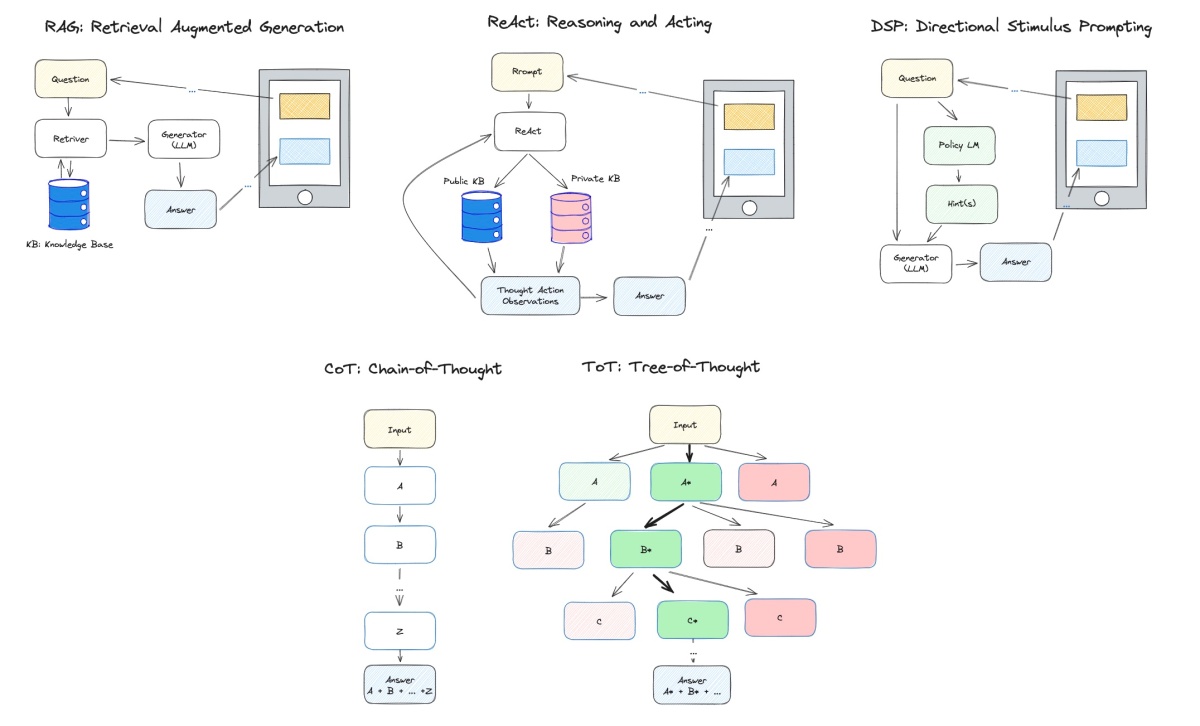
RAG (Retrieval-Augmented Generation): RAG typically refers to a model that combines both retrieval and generation approaches. It might use a retrieval mechanism to retrieve relevant information from a database or knowledge base and then generate a response based on that retrieved information. In real applications, the users’ input and the model’s output will be pre/post-processed to follow certain rules and obey laws and regulations.

RAG: Retrieval-Augmented Generation

Here is a simplified example of using a Retrieval-Augmented Generation (RAG) model for a question-answering task. In this example, we’ll use a system that retrieves relevant passages from a knowledge base and generates an answer based on that retrieved information.

Input:

User Query: What are the symptoms of COVID-19?

Knowledge Base:

1. Title: Symptoms of COVID-19
Content: COVID-19 symptoms include fever, cough, shortness of breath, fatigue, body aches, loss of taste or smell, sore throat, etc.

2. Title: Prevention measures for COVID-19
Content: To prevent the spread of COVID-19, it's important to wash hands regularly, wear masks, practice social distancing, and get vaccinated.

3. Title: COVID-19 Treatment
Content: COVID-19 treatment involves rest, hydration, and in severe cases, hospitalization may be required.

RAG Model Output:

Generated Answer: 

The symptoms of COVID-19 include fever, cough, shortness of breath, fatigue, body aches, etc.

Remark: ChatGPT 3.5 will give basic results like the above. But, Google Bard will provide extra resources like CDC links and other sources it gets from the Search Engines. We could guess Google used a different framework to OpenAI.

CoT: Chain-of-Thought

Chain-of-thought (CoT) prompting (Wei et al. 2022) generates a sequence of short sentences to describe reasoning logics step by step, known as reasoning chains or rationales, to eventually lead to the final answer.

The benefit of CoT is more pronounced for complicated reasoning tasks while using large models (e.g. with more than 50B parameters). Simple tasks only benefit slightly from CoT prompting.

Tree of Thoughts (Yao et al. 2023) extends CoT by exploring multiple reasoning possibilities at each step. It first decomposes the problem into multiple thought steps and generates multiple thoughts per step, essentially creating a tree structure. The search process can be BFS or DFS while each state is evaluated by a classifier (via a prompt) or majority vote.

CoT : Chain-of-Thought and ToT: Tree-of-Thought

Self-Ask + Search Engine

Self-Ask (Press et al. 2022) is a method to repeatedly prompt the model to ask follow-up questions to construct the thought process iteratively. Follow-up questions can be answered by search engine results.

Self-Ask+Search Engine Example

ReAct: Reasoning and Acting

ReAct (Reason + Act; Yao et al. 2023) combines iterative CoT prompting with queries to Wikipedia APIs to search for relevant entities and content and then add it back into the context.

In each trajectory consists of multiple thought-action-observation steps (i.e. dense thought), where free-form thoughts are used for various purposes.

Example of ReAct from pp18.(Reason + Act; Yao et al. 2023)
ReAct: Reasoning and Acting

Specifically, from the paper, the authors use a combination of thoughts that decompose questions (“I need to search x, find y, then find z”), extract information from Wikipedia observations (“x was started in 1844”, “The paragraph does not tell x”), perform commonsense (“x is not y, so z must instead be…”) or arithmetic reasoning (“1844 < 1989”), guide search reformulation (“maybe I can search/lookup x instead”), and synthesize the final answer (“…so the answer is x”).

DSP: Directional Stimulus Prompting

Directional Stimulus Prompting (DSP, Z. Li 2023), is a novel framework for guiding black-box large language models (LLMs) toward specific desired outputs.  Instead of directly adjusting LLMs, this method employs a small tunable policy model to generate an auxiliary directional stimulus (hints) prompt for each input instance. 

DSP: Directional Stimulus Prompting

Summary and Conclusion

Prompt engineering involves carefully crafting these prompts to achieve desired results. It can include experimenting with different phrasings, structures, and strategies to elicit the desired information or responses from the model. This process is crucial because the performance of language models can be sensitive to how prompts are formulated.

I believe a lot of researchers will agree with me. Some prompt engineering papers don’t need to be 8 pages long. They could explain the important points in just a few lines and use the rest for benchmarking. 

As researchers and developers delve further into the realms of prompt engineering, they continue to push the boundaries of what these sophisticated models can achieve.

To achieve this, it’s important to create a user-friendly LLM benchmarking system that many people will use. Developing better methods for creating prompts will help advance language models and improve how we use LLMs. These efforts will have a big impact on natural language processing and related fields.

Reference

  1. Weng, Lilian. (Mar 2023). Prompt Engineering. Lil’Log.
  2. IBM (Jan 2024) 4 Methods of Prompt Engineering
  3. Jeff Su (Aug 2023) Master the Perfect ChatGPT Prompt Formula

Google Cloud Professional Machine Learning Engineer Exam Prep Guide and Study Tips

Content created by the author and reviewed by GPT.

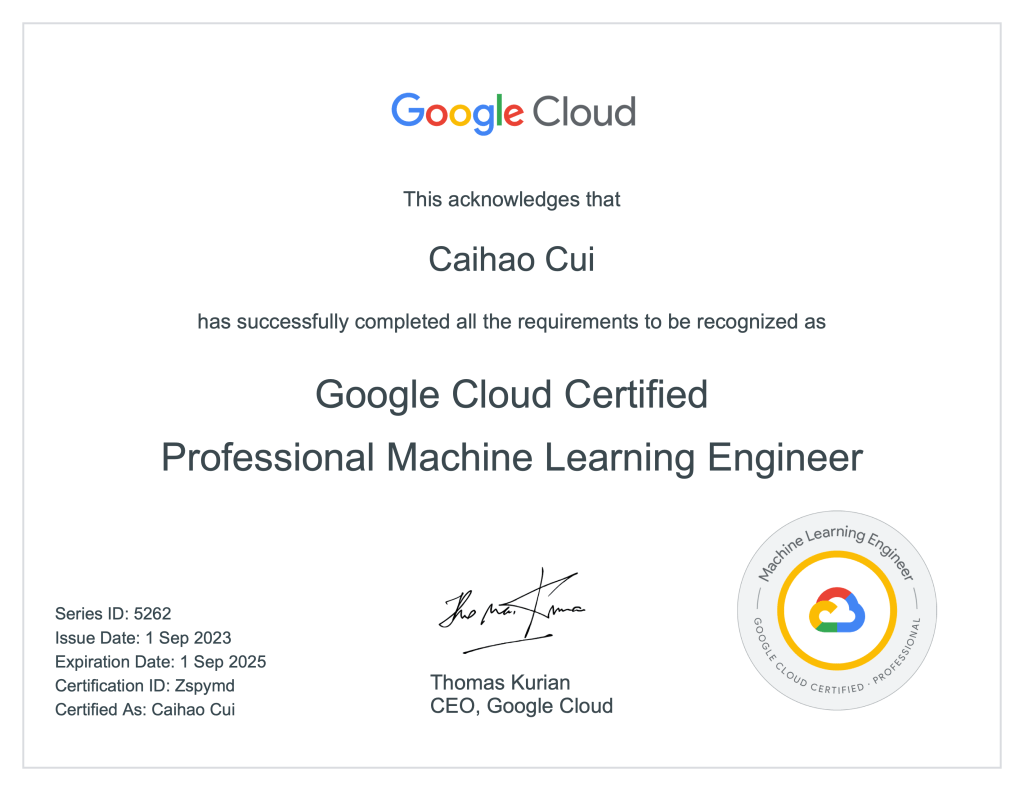
Obtaining the Google Cloud Professional Machine Learning Engineer (MLE) certification is a remarkable achievement for those interested in a machine learning career. As someone who recently passed the exam, I’m here to share helpful tips and insights about the journey. Whether you’re considering taking the exam or currently preparing for it, I hope this guide will help you with valuable information based on my experience.

Three Steps in Preparation

Step 1: Read the Exam Guide Thoroughly

Before diving into your exam preparation, start by carefully reading the official Exam Guide provided by Google. This document is the roadmap for us to understand the key topics and expectations for the certification.

It’s essential to have a clear grasp of what the exam covers before we begin our study journey. Revisit the ML basics via Google’s Crash Course to clarify the details.

Step 2: Learn Best Practices for Implementing ML on Google Cloud

Machine learning is a dynamic field with various approaches and techniques. Google provides best practices for implementing ML solutions on their platform, and this practical knowledge is invaluable. Learning these best practices will not only help us in the exam but also equip us with the skills necessary for real-world ML projects.

Official Google documents, which include keywords such as best practice, machine learning solution, and data pipeline, are all worth reading.

Step 3: Consult the ExamTopic Website

The ExamTopic website is a valuable resource for exam preparation. However, it’s essential to use it strategically. This resource is not a “cheat sheet” or a “shortcut” to the exam, so save it for later, like after we’ve refreshed our knowledge through reading the official documentation and best practices.

While ExamTopic can provide insights into potential exam questions, remember that there are no official answers. The answers offered on the web and those voted ones by users may not be correct.

Get Ready for Exam and Study Tips
  1. Exam Online or Onsite
    • There are two ways to take the exam: Online and Onsite. If you choose the online option, make sure your home WIFI is stable and your system is checked (webcam, microphone, Secure Browser).
    • You will be asked to adjust your device’s security settings, such as turning off the Firewall or enabling screen sharing. If you’re not comfortable making these changes, consider booking an Onsite Exam.
    • If any issues arise during the exam, don’t panic! Just contact Kryterion support team through Live Chat. They can help with things like reopening the launch button for you or adjusting the time.
    • The key is to stay calm and reach out for help if needed to ensure a smooth exam experience!
  2. Reading vs. Watching
    • In the age of abundant online resources, it’s tempting to jump straight into video tutorials and courses. However, for the best retention of knowledge, start by actively reading Google’s documentation.
    • Passive learning through watching videos may lead to omitted details. Reading engages your mind and helps you absorb information effectively.
  3. Understand Trade-offs
    • Machine learning involves making critical decisions, such as balancing speed and accuracy. Take the time to understand the trade-offs involved in various ML solutions. This understanding will prove invaluable not only in the exam but also in real-world ML projects.
  4. Reading Comprehension
    • During the exam, we will encounter questions that provide background information on a problem, stakeholder expectations, and resource limitations. Treat these questions like reading comprehension exercises, as key details hidden within can guide us to the correct answer. Pay close attention to keywords that may hold the solution.
  5. Time Management
    • The exam requires answering 60 questions within a limited timeframe like 2 hours, which may vary in the future. Manage our time wisely by marking questions we’re unsure about for review later.
    • Prioritize the questions we can confidently answer first and revisit the marked ones before submitting our exam in the end.
  6. Stress Management
    • Even if you tell yourself not to stress, it’s natural to feel some pressure during the exam.
    • Consider conducting simulated practice exams to strengthen your nerves, especially in the case that you haven’t taken any exam for a long time. This practice can help improve your mental preparedness for the actual exam.

In the end, I wish you the best of luck in your journey towards achieving the Google Cloud Professional Machine Learning Engineer certification. Remember that diligent preparation, careful reading, and a strategic approach to resources can significantly enhance your chances of success.

Stay confident, stay focused, and may you pass the exam as soon as possible!

-END-

Encourage the Author to create more useful and interesting articles.

All the money will be donated to the Standford Rural Area Education Program (https://sccei.fsi.stanford.edu/reap) at the end of each Financial Year + my personal donation.

$2.00