

English Podcast
中文版本
最近,Y Combinator 请来了 Bob McGrew ——前 OpenAI 首席研究官,同时也是 PayPal 和 Palantir 的资深技术骨干。令人意外的是,在场的创业者们并没有追问他“如何打造下一个 GPT”,反而一窝蜂地想知道:Palantir 的 FDE 模式究竟是怎么运作的?Bob 也坦言,过去一年里,他为无数创业公司提供过咨询,几乎所有人都在痴迷研究这种模式如何真正落地。
什么是 FDE?
FDE(Forward Deployed Engineer,前线部署工程师) 的核心理念,是把工程师直接派驻到客户一线,负责打通“理想产品”与“真实需求”之间的鸿沟。这一思路最早源于 Palantir 服务美国情报机构的岁月。那时客户的挑战极其复杂、没有任何现成模板,只能“现场拼凑”解决方案。起初,很多人认为这种模式无法规模化、太过劳动密集,不符合标准化的 SaaS 理念。可如今,正在探索 AI Agent 与企业级落地的创业公司们,却纷纷把它奉为圭臬。
它是如何运作的
Palantir 把 FDE 团队拆分为两类角色:
- Echo:行业洞察者,深入客户工作流程,挖掘核心痛点,敢于质疑现状。
- Delta:技术实干家,能够在现场快速迭代,把想法变成可运行的原型。
与此同时,总部的 核心产品团队 则把这些前线临时拼凑的“碎石路”经验,沉淀为真正的平台功能——就像把碎石铺成的便道逐步升级为可复用的高速公路。
为什么它重要
FDE 模式最大的优势,是能和客户建立极深的合作关系,发现那些任何调研或问卷都无法揭示的真实需求。执行得好,它能形成强大的护城河。但风险同样存在。如果缺乏纪律,FDE 很容易沦为传统咨询或外包。判断是否健康的关键在于:核心产品是否在持续进化?交付效率是否在不断提高?如果只是人海战术的项目交付,那就南辕北辙了。
与咨询的本质区别
关键差异在于:
- 咨询 只解决一次性问题。
- FDE 则要求把一线的经验和解决方案反馈到平台中,让产品每服务一个客户就更强大一分。
这种反馈闭环,以及产品经理把定制需求抽象为通用功能的能力,才是 FDE 的真正精髓。
为什么 AI 创业公司都在效仿
对 AI Agent 公司而言,市场过于碎片化和不确定,不存在“通吃型”产品。深度嵌入客户现场,不是可选项,而是唯一的探索路径。唯有如此,才能找到真正的产品形态和市场契合点。
商业模式的变化
传统 SaaS 依赖订阅规模化,而 FDE 合同更偏向结果导向与灵活定价。这里的关键杠杆是 产品杠杆:同样的前线投入,能否带来更大的合同规模,同时不断降低下一次定制的边际成本。
更大的图景
FDE 的流行揭示了现代科技公司的一个悖论:规模化的公司,往往要坚持做那些“无法规模化的事”。AI 的能力正在爆发,但距离真正落地仍有巨大鸿沟。而正是在这个鸿沟里,蕴藏着当下创业公司最大的机会。这不是一条轻松的道路,更像是长期的阵地战,而非一蹴而就的闪电战。但对创业者来说,它或许是唯一可行的道路。
【人工智能】什么是FDE?为何在硅谷爆火? | 前线部署工程师 | Bob McGrew | Palantir | 历史成因 | PMF | 总部产品平台 | Echo&Delta团队 | 历史倒退?
Recently, Y Combinator hosted Bob McGrew, the former Chief Research Officer at OpenAI and a veteran technologist from PayPal and Palantir. What surprised many was the line of questioning. Instead of asking him how to build the next GPT, founders kept pressing him on a very different topic: Palantir’s FDE model.
Bob admitted that over the past year, nearly every startup he’s advised has been obsessed with learning how this model works in practice.
What Exactly Is FDE?
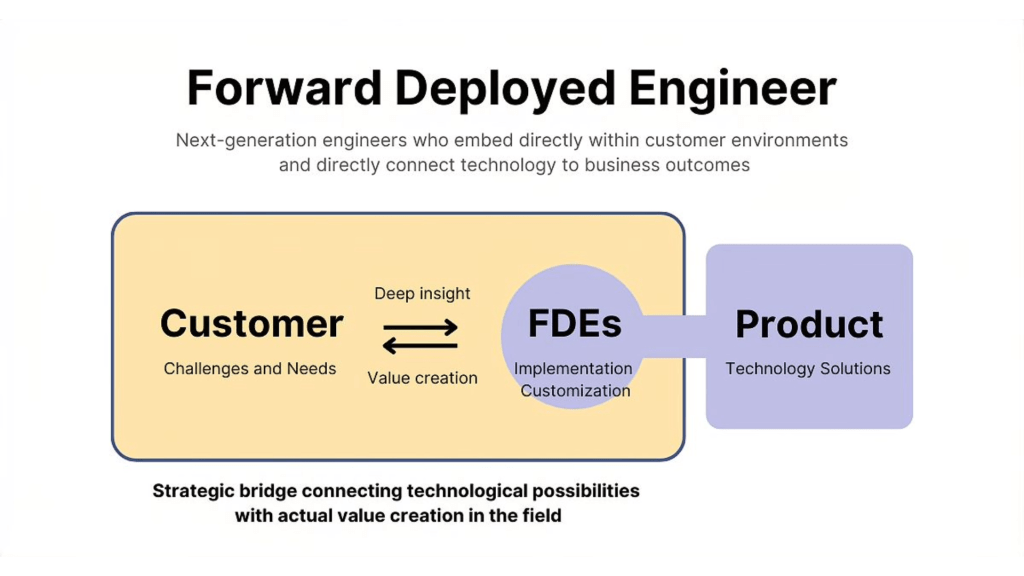
FDE (Forward Deployed Engineer) is a model where engineers embed directly with customers to bridge the gap between what the product aspires to be and what the customer actually needs.
The idea traces back to Palantir’s early days working with U.S. intelligence agencies. The challenges were messy, complex, and had no off-the-shelf solutions. The only way forward was to “build on the ground” with the client. At the time, many dismissed it as unscalable, labor-intensive, and far from the clean SaaS ideal. Fast forward to today, and the very same approach is being embraced by AI startups building agents and enterprise solutions.
How It Works
Palantir structured its FDE teams around two roles:
- Echo: the industry-savvy operator who lives inside the customer’s workflow, identifies core pain points, and challenges the status quo.
- Delta: the technical builder who can spin up prototypes quickly, solving problems in real time.
Meanwhile, the core product team back at HQ takes these frontline hacks and turns them into platform features. Think of it as paving a permanent road where the FDEs first laid down gravel.
Why It Matters
The strength of the FDE model is that it forges unusually deep relationships with customers. It surfaces real market demand—things no survey or user interview could ever uncover. Done right, it creates a defensible moat.
But it’s also risky. Without discipline, FDE can collapse into traditional consulting or body-shop outsourcing. The litmus test of a healthy model is whether the core platform keeps evolving, making each new deployment faster, cheaper, and more scalable.
Different from Consulting
The distinction is critical:
- Consulting delivers one-off solutions.
- FDE is about feeding learnings back into the product, so the platform gets stronger with every customer.
This feedback loop—and the ability of product managers to abstract from bespoke requests—is what turns customer-specific fixes into reusable product capabilities.
Why AI Startups Love It
For AI Agent companies, the market is far too fragmented and unpredictable for a “one-size-fits-all” solution. No universal product exists. Embedding deeply with customers isn’t optional—it’s the only way to figure out what works, discover product-market fit, and build enduring platforms.
A Shift in Business Models
Unlike traditional SaaS, which scales on pure subscriptions, FDE contracts are more outcome-driven and flexible. The key lever is product leverage: doing the same amount of frontline work but translating it into larger contracts and less marginal customization over time.
The Bigger Picture
The rise of FDE highlights a paradox of modern tech: at scale, the best companies keep doing the things that “don’t scale.” The gulf between breakthrough AI capabilities and messy, real-world adoption is exactly where the biggest opportunities lie today.
It’s not an easy path—more trench warfare than blitzscaling—but for founders, it may be the only one that works.
Watch the full discussion here: The FDE Playbook for AI Startups with Bob McGrew
 C. Cui's Blog