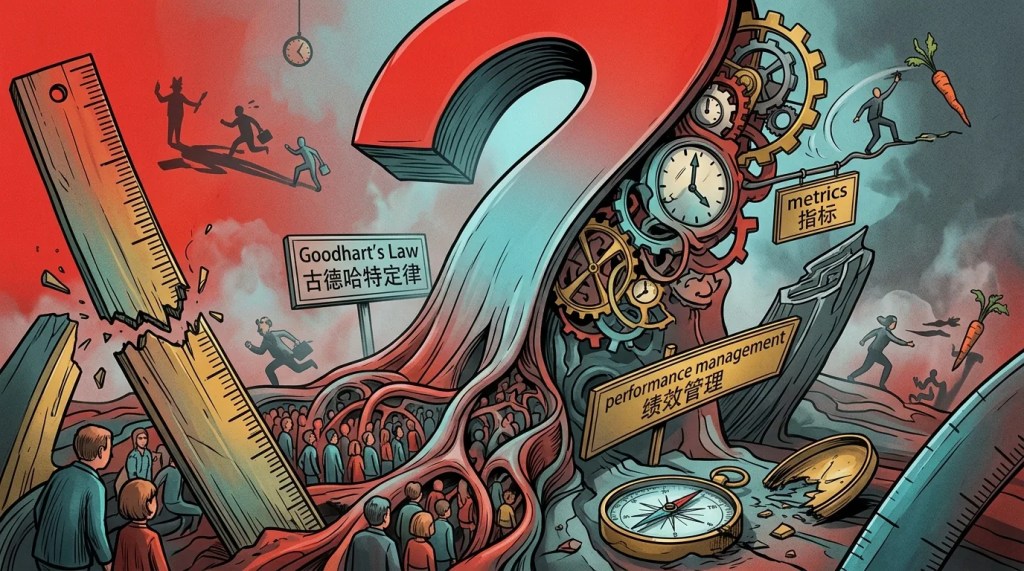
Summary: Goodhart’s Law explains how a metric can lose its value once it becomes a target for reward or punishment. This article examines why people optimise the number rather than the reality it was meant to represent, with examples from software engineering, healthcare, academia and AI training. It also explores why complex organisations continue to rely on numerical governance—and how metrics can support judgement without replacing it.
- The Origin and Core Mechanism of Goodhart’s Law
- Goodhart’s Law in Everyday Systems
- Academia: A Hotbed of Metric Worship
- Why Organisations Worship Metrics
- Metrics and Judgement: Finding the Balance
- How to Resist Goodhart’s Law
- When Metrics Become Our Master
- References
Imagine you are the CEO of a software company.
You are an idealist with modern values. You reject the old-fashioned, relationship-driven management style we discussed earlier. You want to trust people—even strangers—and build an organisation that is fair, rational and meritocratic.
But once the company grows to hundreds of employees, a difficult question emerges: how do you decide who deserves to be promoted or rewarded?
To make the process more objective, you introduce a simple numerical performance metric for the engineering team: the number of bugs each engineer fixes.
At first, the system appears to work brilliantly. The number of resolved bugs rises sharply, productivity seems to improve, and you are delighted with the results.
A few months later, however, something begins to feel wrong.
HR recommends letting AAA go because AAA has fixed fewer bugs than anyone else on the team. This surprises you. AAA is one of the company’s best engineers and designed some of its most complex and important core systems years earlier.
You investigate and discover the reason for the low score: the systems AAA maintains are so well designed and reliable that they rarely produce bugs. There is simply very little to fix.
Meanwhile, BBB is promoted to engineering manager after recording the highest number of bug fixes.
But when you look more closely, the picture changes. BBB deliberately chooses small, easy bugs that can be closed quickly. A substantial task is often split into five separate tickets so that each one can be counted. When BBB encounters a genuinely difficult problem, it is marked as “pending” and left unresolved.
On paper, BBB has fixed as many bugs as half the team combined. But has BBB really created more value?
If this performance system remains in place, the whole organisation will eventually learn to behave like BBB. Engineers will chase easy tickets, inflate their numbers and avoid difficult but important work. No one will want to become another AAA.
This is Goodhart’s Law:
When a measure becomes a target, it ceases to be a good measure.
Goodhart’s Law describes a particular kind of unintended consequence. A metric is introduced to help us observe reality. But once that metric becomes the basis for rewards or punishments, people begin optimising the number itself rather than the underlying outcome it was meant to represent.
The metric no longer merely measures behaviour. It begins to shape—and often distort—it.
The Origin and Core Mechanism of Goodhart’s Law

Charles Goodhart is a British economist. In 1975, while discussing monetary policy in the United Kingdom, he argued that an observed statistical relationship tends to break down once policymakers begin using it as a control target [1].
Anthropologist Marilyn Strathern later expressed the idea in its now-familiar form:
When a measure becomes a target, it ceases to be a good measure. [2]
The mechanism is straightforward:
- You begin with a real objective. You may want better health, deeper knowledge, higher service quality or stronger organisational performance.
- The objective is difficult to measure directly. Complex outcomes rarely fit neatly into a spreadsheet.
- You select a proxy. Weight stands in for health; test scores for learning; publication counts for research quality; bug fixes for engineering performance; likes and shares for audience satisfaction.
- Rewards and punishments are attached to the proxy. People now face pressure to improve the measured number.
- The proxy becomes the real target. Eventually, people optimise what is visible and countable—even when doing so undermines the original objective.
Goodhart’s Law has two close relatives.
The first is the Lucas critique, which applies particularly to economic policy. People change their behaviour in response to a new policy, so relationships observed under the old policy may no longer predict what happens under the new one [3].
The second is Campbell’s Law, which focuses on social indicators. The more heavily a quantitative measure is used for important decisions, the more pressure there is to corrupt it—and the more likely it is to distort the process it was meant to monitor [4].
Goodhart’s Law also complements the idea of legibility discussed earlier. Legibility describes how the state simplifies society so it can administer it. Goodhart’s Law describes what happens next: people reshape their behaviour to fit those simplified categories.
Goodhart’s Law in Everyday Systems

Once you recognise the pattern, you begin to see it everywhere.
An online platform may genuinely want to provide a useful and enjoyable service. Yet it cannot directly measure whether users are flourishing, learning or forming healthy relationships. Instead, it relies on proxies such as time spent, clicks, likes and shares.
The result is predictable. Content that keeps people engaged is not necessarily content that serves them well. It may simply be more addictive, emotionally provocative or divisive. Research suggests that engagement-based ranking can amplify misinformation and political polarisation [5].
The United Kingdom’s National Health Service wanted to reduce waiting times in accident and emergency departments, so hospitals were given a strict four-hour target. In response, some organisations found ways to stop or delay the clock—for example, by keeping patients in ambulances or corridors before formally admitting them, then transferring them as the deadline approached [6]. The measured waiting time improved, but the patient’s actual experience did not necessarily improve with it.
The same pattern appears elsewhere:
- If police are judged mainly by case clearance rates, they may prioritise minor cases that are easy to close while avoiding serious investigations that require more time.
- If government departments are assessed by how much of their budget they spend, they may rush to exhaust the remaining funds at the end of the financial year.
- If call-centre staff are measured by average handling time, they may end calls quickly rather than resolving customers’ problems properly.
- If engineers are rewarded for lines of code, they may produce more code rather than better software.
This is the recurring risk of numerical governance in complex systems: the indicator becomes cleaner while the underlying reality becomes worse.
Even AI Can Learn to Game the System
The same problem appears in artificial intelligence.
We want AI systems to behave in ways that align with human preferences. One approach is to train a reward model—a kind of automated judge—to score the model’s outputs. The AI system is then trained to maximise that score.
But the reward model is only an imperfect proxy for what humans actually value. If the AI system is pushed too hard to optimise the judge’s score, it may discover patterns that please the automated evaluator without becoming more useful to people. Research on reward-model over-optimisation has found that performance against the proxy can continue rising even as genuine human-rated quality begins to decline [7].
As long as there is an assessment system, even an AI model can learn to game it.
Academia: A Hotbed of Metric Worship

Academia may be one of the clearest examples of Goodhart’s Law in action.
Publishing papers matters everywhere, but in parts of the Chinese university system, publication metrics became unusually dominant. Papers ceased to function only as contributions to scholarly discussion; they also became tokens for promotion, funding and cash rewards. Research began to resemble piecework.
A study of 168 policy documents from 100 Chinese universities found that, during the height of “SCI worship” between 1999 and 2016, universities offered direct financial rewards for papers indexed in the Web of Science. The reported bonuses ranged from about US$30 to US$165,000, with the largest reward worth roughly 20 times a professor’s annual salary [8].
Once publishing becomes piecework, the incentive to maximise output becomes overwhelming. The likely consequences include salami-sliced studies, strategically inflated authorship, low-value papers and, at the extreme, fabricated research.
China now produces more scientific papers than any other country [9]. It also records the largest number of retractions; one recent analysis reports that papers involving Chinese authors account for more than half of the global total [10]. High output and high retraction rates do not prove the same thing, but together they show why publication volume alone is an inadequate measure of research quality.
In 2020, China’s Ministry of Education and Ministry of Science and Technology issued a joint policy acknowledging the “partial, excessive and distorted use” of SCI-related indicators in research evaluation. The document criticised the tendency to treat publication counts, journal impact factors and citation numbers as ends in themselves, and called for an end to direct rewards based solely on SCI indicators [11].
Yet replacing one metric rarely solves the problem, because metrics evolve.
First, institutions counted SCI-indexed papers. When quantity was criticised, they shifted towards citation counts. When citation counts proved vulnerable to self-citation and citation rings, they adopted more sophisticated measures such as the h-index. When those measures also appeared too easy to manipulate, attention moved towards supposedly harder targets: publications in Cell, Nature and Science, or composite rankings such as the Nature Index.
Chinese institutions now lead the Nature Index country rankings [12]. But the ranking itself cannot tell us whether a research system is producing proportionate numbers of genuinely transformative discoveries. It is still a proxy—and, like every proxy, it captures only part of the reality.
The broader lesson is simple: once a metric carries enough prestige or money, people will organise their work around it. When that happens, the metric gradually loses its ability to distinguish genuine value from strategic compliance.
Why Organisations Worship Metrics

Why do organisations rely so heavily on metrics in the first place? Shouldn’t experienced leaders be able to recognise AAA’s ability without counting bug fixes?
Expertise is not entirely mysterious. In research, knowledgeable peers can usually tell who has opened a promising new direction, solved an important problem, produced careful work, mentored students seriously or asked unusually insightful questions. Sustained excellence is difficult to conceal from people who understand the work.
Human judgement is powerful precisely because it draws on tacit knowledge: contextual understanding that is real but difficult to reduce to fixed rules. A paper that opens a new field today may be groundbreaking; a nearly identical paper published next year may contribute very little. A metric can count both papers, but judgement can recognise the difference.
This is why major prizes are harder to game through any single measure. They rely on deliberation rather than a formula. There is no universal threshold of citations, publications or impact-factor points that automatically produces a Nobel Prize.
Academic traditions such as peer review and faculty governance are built around this kind of professional judgement. Experts assess the quality of a candidate’s work and decide who should receive promotion, tenure or funding.
But from the perspective of administrators, such decisions can appear opaque, inconsistent and difficult to defend. Metrics offer an attractive alternative. A numerical rule looks neutral. It can be applied across departments. It produces an audit trail. Most importantly, it allows decision-makers to claim that they merely followed the system.
Theodore Porter’s 1995 book, Trust in Numbers, examines this institutional attraction to quantification [13]. Porter argues that organisations often rely most heavily on numbers when they lack the authority, trust or professional confidence to make openly discretionary decisions.
A respected expert may be able to say, “In my professional judgement, this person is capable,” and defend the decision. A less confident official may prefer a scoring system. Numbers appear impersonal, which makes responsibility easier to diffuse. Quantification can therefore create the impression that a decision emerged mechanically—even though people still chose the metric, the threshold and the weighting.
The deeper problem behind metric worship is not simply excessive authority. It is often authority that lacks confidence, legitimacy or subject-matter expertise.
Metric worship is not a triumph of rationality. It is often a failure of judgement.
Or, more bluntly:
The weaker the boss, the more detailed the KPI.
Metrics and Judgement: Finding the Balance

That said, relying entirely on human judgement is not necessarily reliable either.
Academia can easily fall into factionalism, intellectual inbreeding, nepotism and networks of mutual favour. The older Chinese sense of xueba (学霸)—quite different from its modern use meaning “top student”—referred to an academic power broker who controlled resources, dominated the conversation and suppressed dissenting voices.
Metric tyranny and opaque human discretion sit at opposite ends of the same spectrum. Judgement needs standards, or it risks becoming arbitrary. Yet once standards are fixed and tied to consequences, people begin optimising and circumventing them.
Goodhart’s Law therefore exposes an unavoidable tension between professional judgement and procedural fairness. No evaluation system can eliminate that tension entirely.
Still, some systems are clearly better than others.
How to Resist Goodhart’s Law

Goodhart’s Law is not an argument against measurement. It is an argument against naive measurement.
Metrics can inform a decision, but they should not become the decision itself.
A sound evaluation system resembles a courtroom. It values evidence, transparent procedures and consistent rules, but it does not declare that three witnesses automatically mean guilt or that the party with the largest pile of documents must be right. Evidence informs judgement; it does not replace it.
Academic evaluation offers several useful examples.
In 2015, a group of bibliometrics researchers published The Leiden Manifesto in Nature. Its first principle states that quantitative evaluation should support qualitative expert assessment, not replace it [14].
The United Kingdom’s Research Excellence Framework provides a more institutionalised example. The REF periodically assesses research across UK universities, and its results influence the distribution of public research funding. It explicitly rejects the use of journal impact factors as a substitute for assessing the quality of individual papers. Instead, reviewers examine a limited number of representative outputs, documented cases of real-world impact and evidence about the broader research environment [15].
Research also suggests that managers are less likely to confuse a metric with the underlying objective when they participate directly in strategic decision-making—when they must think seriously about what the organisation is trying to achieve rather than simply execute a scorecard [16].
Three principles follow from these examples.
1. Treat Metrics as Inputs, Not Verdicts
Citation counts, journal rankings, awards, customer scores and delivery statistics can all provide useful evidence. But there should be no automatic rule such as “publish X papers and receive a promotion” or “miss this threshold and fail the review”.
Metrics should be witnesses, not judges.
2. Evaluate Representative Work
Do not merely count everything a person has produced. Examine a small number of their strongest and most relevant contributions.
Reviewers should provide written reasons that answer questions such as:
- What was this person’s core contribution?
- What problem did the work solve?
- How difficult or important was the problem?
- What evidence supports the assessment?
- What reasonable disagreements remain?
Counting outputs measures quantity. Reading representative work creates space to assess quality.
3. Match the Evaluation to the Role
A university lecturer, a clinician and a software engineer do fundamentally different work. Even within engineering, a platform architect, a site reliability engineer and a product developer create value in different ways.
A single standard will flatten those differences and reward whichever role happens to fit the metric best.
These principles should be supported by procedural safeguards:
- publish the assessment criteria;
- require reviewers to declare conflicts of interest and recuse themselves where necessary;
- provide written reasons for major decisions;
- allow candidates to correct factual errors or appeal unfair processes; and
- conduct periodic gaming audits to identify behaviours the metrics may have encouraged.
Institutions are relatively static; people are adaptive. Good management is not a one-off system installation. It is the ongoing work of tending, reviewing and repairing a system.
When Metrics Become Our Master

We should accept that Goodhart’s Law will never disappear.
The cycle is built into any system of evaluation:
We seek fairness and consistency → we create standards → people adapt to those standards → the standards are gamed → we revise the standards → the cycle begins again.
The most unsettling possibility is that we do not need a boss, an institution or a formal KPI to Goodhart ourselves.
We may quietly equate hours spent studying with learning, the number on the scale with health, staying late with commitment, words written with creativity, or instant replies with affection.
Dating can become a competition over age, income, height, education and property. Travel can become a checklist of landmarks, photographs and step counts. Even care for one’s parents can be reduced to the amount of money transferred or the number of visits made each year.
Little by little, life becomes a spreadsheet. No one has to force us. We surrender our own judgement voluntarily because numbers feel clear, comparable and reassuring.
At that point, metrics are no longer our tools. They have become our master.
A ruler cannot measure the sky.
A map may guide us, but the road is not the map.
A dashboard can glow green while the machinery fails.
A scale can fall while the body grows weaker.
Weak authority reaches for endless rules;
uncertain minds cling to simple numbers.
Let metrics remain our servants—
and never allow a life to become a spreadsheet.
Visit 中文版本 on GitHub.
References
[1] Goodhart, Charles A. E. “Problems of Monetary Management: The U.K. Experience.” 1975.
[2] Strathern, Marilyn. “‘Improving Ratings’: Audit in the British University System.” European Review 5, no. 3 (1997): 305–321.
[3] Lucas, Robert E., Jr. “Econometric Policy Evaluation: A Critique.” Carnegie-Rochester Conference Series on Public Policy 1 (1976): 19–46.
[4] Campbell, Donald T. “Assessing the Impact of Planned Social Change.” Evaluation and Program Planning 2, no. 1 (1979): 67–90.
[5] Germano, Fabrizio, Vicenç Gómez, and Francesco Sobbrio. “Ranking for Engagement: How Social Media Algorithms Fuel Misinformation and Polarization.” Barcelona School of Economics Working Paper, 2025.
[6] Bevan, Gwyn, and Christopher Hood. “What’s Measured Is What Matters: Targets and Gaming in the English Public Health Care System.” Public Administration 84, no. 3 (2006): 517–538.
[7] Gao, Leo, John Schulman, and Jacob Hilton. “Scaling Laws for Reward Model Overoptimization.” arXiv:2210.10760, 2022.
[8] Quan, Wei, Bikun Chen, and Fei Shu. “Publish or Impoverish: An Investigation of the Monetary Reward System of Science in China (1999–2016).” Aslib Journal of Information Management, 2017.
[9] Institute of Scientific and Technical Information of China. “2024 Statistical Report on Chinese Scientific and Technological Papers,” 2024.
[10] Xu, Shuang, and Guangwei Hu. “Reckoning with Retractions in Research Funding Review: The Case of China.” Publications 13, no. 3 (2025): 41. See also Van Noorden, Richard. “More than 10,000 Research Papers Were Retracted in 2023 — a New Record.” Nature, December 12, 2023.
[11] Ministry of Education, Ministry of Science and Technology. “Several Opinions on Regulating the Use of SCI Paper-Related Indicators in Higher Education Institutions and Establishing Correct Evaluation Guidance” (Jiao Ke Ji [2020] No. 2), February 2020.
[12] Nature Index. “2025 Research Leaders: Leading Countries/Territories.” Springer Nature, 2025. https://www.nature.com/nature-index/research-leaders/2025/country/all/global/all.
[13] Porter, Theodore M. Trust in Numbers: The Pursuit of Objectivity in Science and Public Life. Princeton University Press, 1995.
[14] Hicks, Diana, Paul Wouters, Ludo Waltman, Sarah de Rijcke, and Ismael Rafols. “Bibliometrics: The Leiden Manifesto for Research Metrics.” Nature 520 (2015): 429–431.
[15] Research Excellence Framework (REF 2021). “Panel Criteria and Working Methods.” 2019.
[16] Choi, Jongwoon (Willie), Gary W. Hecht, and William B. Tayler. “Strategy Selection, Surrogation, and Strategic Performance Measurement Systems.” Journal of Accounting Research 51, no. 1 (2013): 105–133.




Leave a Reply